Every year, the same scenario plays out between late September and mid-November: the lawn becomes covered in mounds of fresh soil, leeks topple over for no apparent reason, a celery plant pulls out in one go because it has no roots left. In the garden as in the vegetable patch, autumn is the season of underground damage — and the season when we most often blame the wrong culprit.
Because behind symptoms that look alike, three animals live side by side: the European mole (Talpa europaea), an insectivore and strictly carnivorous; the water vole (Arvicola terrestris, the notorious "mole rat"), vegetarian and formidable; and the wood mouse (Apodemus sylvaticus), an opportunist with a great fondness for bulbs. Confusing them means losing a whole season: methods that work against one are useless against another, and some practices still in common use are now illegal.
Here is the identification guide and the action calendar to put in place in the weeks remaining before the ground freezes.
Why October and November concentrate the damage
Three factors come together in autumn and explain this seasonal peak.
1. Digging activity explodes. With the first rains, the soil softens and becomes easy to work again. The mole, which had dug deep during the dry summer, moves back up towards the surface layer rich in earthworms: hence the sudden blossoming of molehills, often over just a few nights.
2. Rodents are building up their stores. The water vole does not hibernate. It spends the winter in its tunnel network and has to stockpile enough to get through: roots, tubers, crowns. This is precisely the period when your carrots, beetroot, Jerusalem artichokes and young fruit trees become a target. The wood mouse, for its part, builds up caches of acorns, hazelnuts and freshly planted spring bulbs.
3. Populations are at their peak. After a full breeding season, numbers reach their annual high. In the water vole, multi-year cycles are well documented by INRAE: densities can go from a handful of individuals to several hundred per hectare in an outbreak phase, with spectacular damage to grassland and orchards.
In other words: the month of October largely determines what will be left of your vegetable garden come spring.
Identifying the right culprit: the diagnostic table
This is the step everyone skips, and it's the one that changes everything.
| Clue | European mole | Water vole | Wood mouse |
|---|
| Diet | Earthworms, larvae, insects | Roots, tubers, bark | Seeds, bulbs, fruit, insects |
| Mound | Bulky, fine soil, central crater, no visible opening | Smaller, flattened, coarse soil mixed with grass, side opening | No mound, small clean holes 2–3 cm across |
| Tunnel | Round, 5–6 cm, deep | Oval, flattened vertically, often just below the surface | Narrow, at the surface, under the mulch |
| Damage to plants | Indirect (roots left exposed) | Direct: roots cleanly severed, plants toppling over | Hollowed-out bulbs, seeds dug up |
| Presence above ground | Virtually none | Occasional | Frequent at night |
The most reliable field test remains the carrot or apple wedge test: place one in an open tunnel, cover it lightly, and come back 24 hours later. If it has been eaten, you have a vegetarian rodent (water vole or wood mouse), not a mole — which will never touch a vegetable.
A second test is the backfill test: open the tunnel over 10 cm and watch. The mole plugs it by pushing soil in, often within hours. The water vole goes around it or leaves the opening gaping for longer.
Remember: a mole does not eat your vegetables. If the roots are cleanly severed, look for a water vole. And it's common for both to coexist, with the vole happily reusing tunnels abandoned by the mole.
What the regulations say in 2026
This is the point many gardeners are unaware of, and it has become central.
The mole is not an officially "pest" species
The European mole does not appear on the list of species liable to cause damage (ESOD), formerly known as "pests", set out by ministerial decrees. It is not protected, but its destruction is not encouraged for its own sake: it plays a genuine role in aerating the soil and preying on larvae (crane flies, cockchafers, mole crickets).
Above all, the control methods are tightly regulated:
- Fumigant products based on aluminium or magnesium phosphide are not available to private individuals; their use is restricted to certified operators (individual "plant protection products" certificate).
- Home-made "gassing" (exhaust fumes, calcium carbide) is dangerous and has no legal basis whatsoever.
- Strychnine has been banned for decades. Any "miracle" product offered outside official channels should be considered illegal — ANSES regularly points out, backed by its alert bulletins, that banned biocides continue to circulate on informal markets and online, with serious poisonings as a result.
Mechanical trapping therefore remains the reference method for moles for private individuals, with one requirement: a trap must kill outright or capture, never injure. Scissor-type traps such as the "Putange" or tunnel traps are the most widely used models; a good scissor-type mole trap properly set and handled with gloves to limit human scent will deliver better results than ten repellent products.
The water vole falls under a specific framework
For Arvicola terrestris, control is organised collectively by the FREDON bodies (regional federations for protection against harmful organisms) and governed by the decree of 14 May 2014 on vole control. The use of bromadiolone in baits is strictly limited to precise, supervised conditions with prior declaration — never for free use in an ornamental garden, notably because of the risk of secondary poisoning of predators (buzzards, foxes, cats, dogs).
For a private individual, in practical terms this means: trapping + prevention + natural predation, and absolutely no rodenticide baits scattered in the soil.
A reminder about protected species
Two pitfalls to avoid at all costs:
- Shrews (genera Crocidura, Sorex) are protected species in France. They dig very little, eat insects, and are regularly killed by mistake.
- Hedgehogs, also protected, are frequently injured by badly placed or poorly shielded traps. An uncovered surface trap is a hazard.
Protecting the vegetable garden: the barriers that work
Direct control is damage limitation. In autumn, real effectiveness comes from physical barriers installed before winter.
Buried rodent-proof mesh
This is the most worthwhile investment on a small plot. The principles:
- Mesh of 12.5 to 16 mm maximum (a water vole gets through a 2 cm gap, a wood mouse even more easily).
- Buried at least 40–50 cm deep, with an L-shaped return of 10–15 cm facing outwards at the bottom of the trench.
- Standing 20–30 cm above ground if you also want to block surface crossings.
For raised vegetable beds and planters, the simplest solution is to fix fine-mesh galvanised wire netting under the base of the bed before filling it: rodents never come in from above.
Individual protection
For recently planted fruit trees — the most vulnerable, since a water vole can gnaw through the crown and roots of a young apple tree in a single season:
- A wire mesh trunk guard around the crown, buried 15 cm deep, fitted loosely to allow the trunk to thicken.
- Mulch kept away from the crown: thick mulch pressed against the trunk creates an ideal shelter for wood mice and voles.
Rethinking mulch and heaps
Mulching is an excellent agronomic practice… and a hotel for rodents if poorly managed. In October:
- Remove very thick mulch at the base of sensitive crops (carrots, beetroot, salsify) or replace it with mineral mulch.
- Move woodpiles, compost heaps and bags of potting soil at least 3 to 5 metres away from your growing beds.
- Don't leave fallen fruit or sunflower seeds on the ground: they are magnets for wood mice.
Trapping effectively: the rules that make all the difference
Trapping almost always fails for the same reasons. Four points make the difference.
1. Choose the right tunnel. Never set a trap in a molehill: it's a dead end full of spoil. Look for the main run, the one linking the mounds in a straight line, usually 15–25 cm deep. A garden probe or a simple metal rod lets you locate it by feel: the soil's resistance suddenly gives way.
2. Limit your scent. Gloves, traps rubbed with soil, no perfume or petrol. It's basic, and it's decisive.
3. Set multiple stations. A single trap on an active network gives hit-and-miss results. Reckon on 3 to 6 traps set simultaneously on the main runs of a medium-sized garden.
4. Check every day. It's an ethical obligation and a condition of effectiveness: a sprung trap left in place is of no further use.
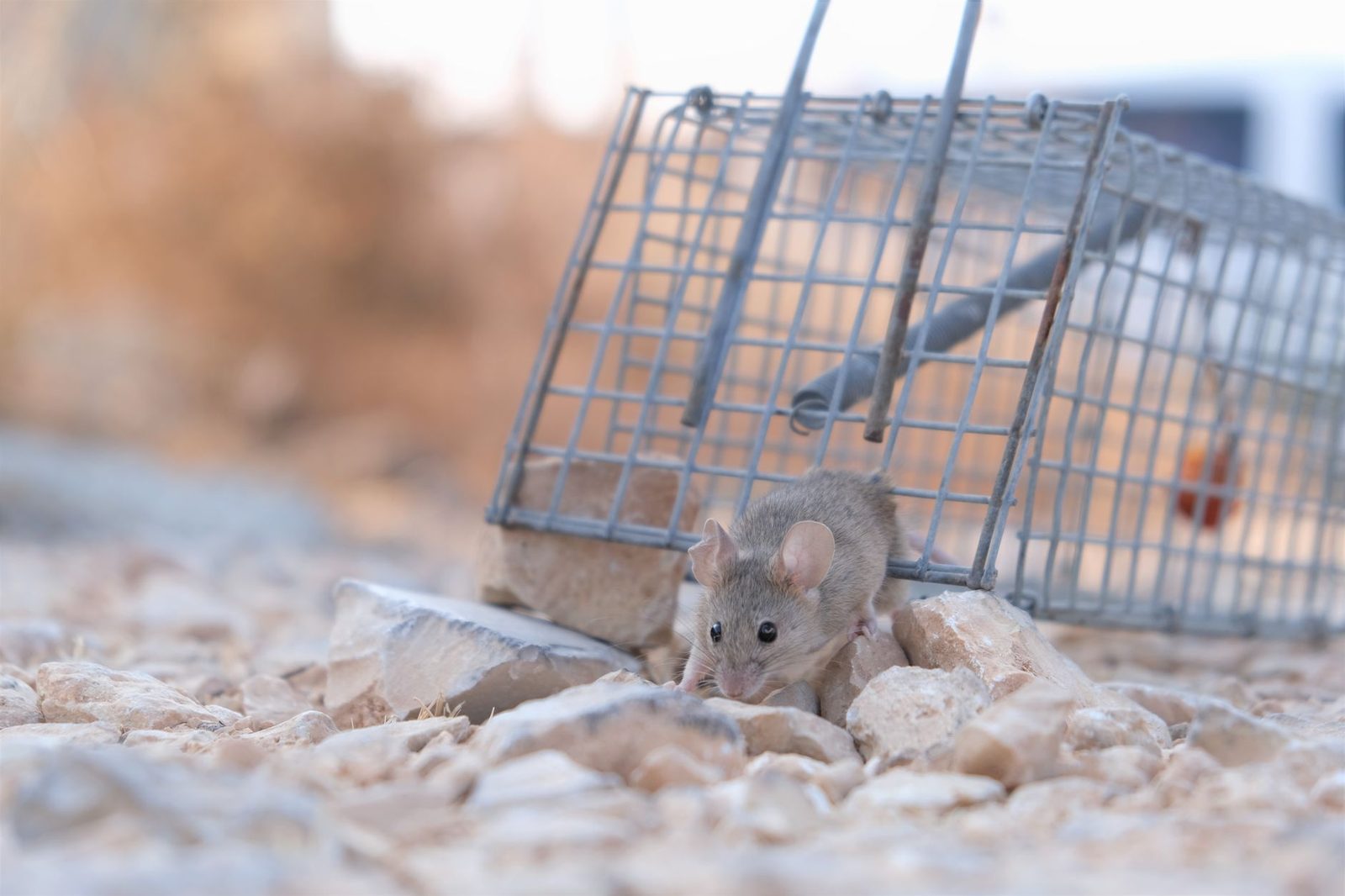
For the water vole and the wood mouse, scissor-type "crocodile clip" traps set in the tunnel, or live-capture cage traps if you want a non-lethal approach for wood mice, give good results. In a garden room, shed or tool store, a simple metal mouse trap placed along the walls is often enough to settle a wood mouse problem before they move in for good — with one absolute precaution: out of reach of pets and children.
Repellents: what works and what doesn't
The market is awash with solutions. Some sorting is called for.
Little or no demonstrated effectiveness:
- Buried ultrasonic devices: the available studies show at best a temporary effect, with rapid habituation. The rodents come back, sometimes just a few metres away.
- Perforated bottles, windmills and vibrating objects: anecdotal effect at best.
- Coffee grounds, hair, dog fur: may shift the animal a few metres, solves nothing.
More credible effects:
- Plants with empirically documented repellent effects (caper spurge, crown imperial, garlic) along bed edges: useful as a complement, not as a stand-alone solution.
- Castor meal, sometimes used as a repellent soil amendment. Caution: it is toxic to dogs and should be avoided in any garden with pets.
The real lever: predation. This is the most effective and least costly measure. A pair of barn owls eats several thousand small mammals a year. Installing a barn owl nest box on a barn or a gable end, leaving a few raptor perches (2–3 m posts with a crossbar) along the edge of the plot, and preserving hedges, stone piles and low walls for stoats and weasels: the Ligue pour la protection des oiseaux (LPO) and the FREDON bodies explicitly recommend these measures in integrated vole control strategies.
Your calendar for the next six weeks
A simple plan, to be worked through in order.
Week 1 — diagnosis. Map the mounds and holes. Carry out the carrot and backfill tests. Mark the active zones on a plan of your garden: it will serve as your reference in spring.
Week 2 — barriers. Fit protective guards on young fruit trees, clear the crowns, remove thick mulch from root crops, move heaps away.
Weeks 2 to 4 — trapping. Set 3 to 6 traps on the main runs, check daily, reposition every 3 days if there are no catches.
Week 4 — early harvest. Lift the carrots, beetroot and celery still in the ground in active zones and store them in a clamp or cellar rather than leaving them to feed the overwintering population.
Weeks 5 to 6 — long-term measures. Barn owl nest box, perches, hedges, buried mesh on your future vegetable bed. Now is the moment: the soil is still workable and the frost hasn't set in.
When to call in a professional
An ornamental garden can often be managed single-handedly. Three situations warrant a call:
- A water vole outbreak in a meadow, an orchard or on a plot larger than a few thousand square metres: collective control coordinated by your region's FREDON is the only approach that holds up over time.
- Damage to structures: tunnels under a terrace, a low wall, a slab or a swimming pool, repeated subsidence. The diagnosis must be made before any work begins.
- Movement from the garden into the house: if wood mice or rats have got into a basement, a garage or a loft, the issue is no longer horticultural but a health matter, and falls to a professional applicator with Certibiocide certification.
In every case, insist on a written species diagnosis, a breakdown of the methods used, and clear information about the risks to pets and wildlife. A contractor offering quick "gassing" with no regulatory detail should send you running.
The essential point, in October, comes down to one sentence: identify before you act. A mole is not a vegetable garden pest, a water vole very much is, and a wood mouse is above all an early warning before they move into the house. The next six weeks, before the ground hardens, are worth more than six months of catching up in spring.
Sources: INRAE (population dynamics of water voles), decree of 14 May 2014 on the control of vole populations harmful to crops, ANSES (alert bulletins on illegal biocides), FREDON France, LPO (habitat measures favouring predators).