On 7 July 2026, a Japanese beetle (Popillia japonica) was caught in Pont (Côte-d'Or), near a major road. The identification was confirmed the next day by the ANSES national reference laboratory (Entomology and Botany Unit). It is the second detection in the Bourgogne-Franche-Comté region in less than a month — the first was on 16 June in Écot, in the Doubs. The prefecture and the DRAAF Bourgogne-Franche-Comté immediately stepped up trapping and are calling on the public to report any sightings. Here is why this sub-one-cent coin-sized insect is worrying the health services so much — and what you should — and shouldn't — do if you spot one in your garden.
The Japanese beetle: a pest under tight watch
Native to Japan and widespread in North America since the early 20th century, Popillia japonica has gradually colonised Europe. It was first detected in Italy in 2014, then in Switzerland in 2017, and in France in Haut-Rhin in the summer of 2025. Its spread is closely linked to milder winters and to road and rail transport flows from the Alpine area.
The insect is now classified by the European Union as a "priority quarantine organism" under Implementing Regulation (EU) 2019/2072. In practical terms, its detection, keeping, transport and spread are banned, and Member States are legally obliged to set up surveillance, trapping and, where possible, eradication. In France, the DGAL (Directorate-General for Food) coordinates the system, supported regionally by the DRAAFs and the FREDONs (Regional Federations for the Defence against Harmful Organisms).
What does it really look like?
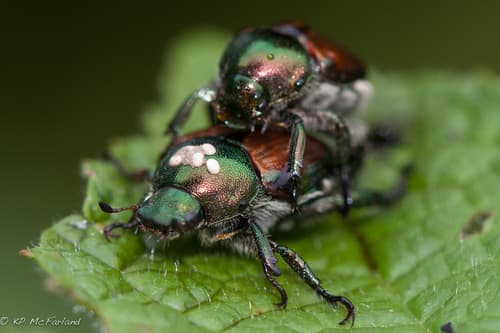
Recognising it is not obvious, because it can be confused with the garden chafer (Phyllopertha horticola) or the European rose chafer, both common and harmless species. A few discriminating features:
- Size: about 10 mm long and 6 mm wide — smaller than a 1 euro cent coin.
- Bright metallic green body on the back, with coppery-brown elytra that do not fully cover the abdomen.
- The major identifying sign: five tufts of white hairs on each side of the abdomen, and one additional tuft at the rear tip — six tufts in total. The garden chafer has none.
- Club-shaped antennae (lamellicorn beetles), like all scarab beetles.
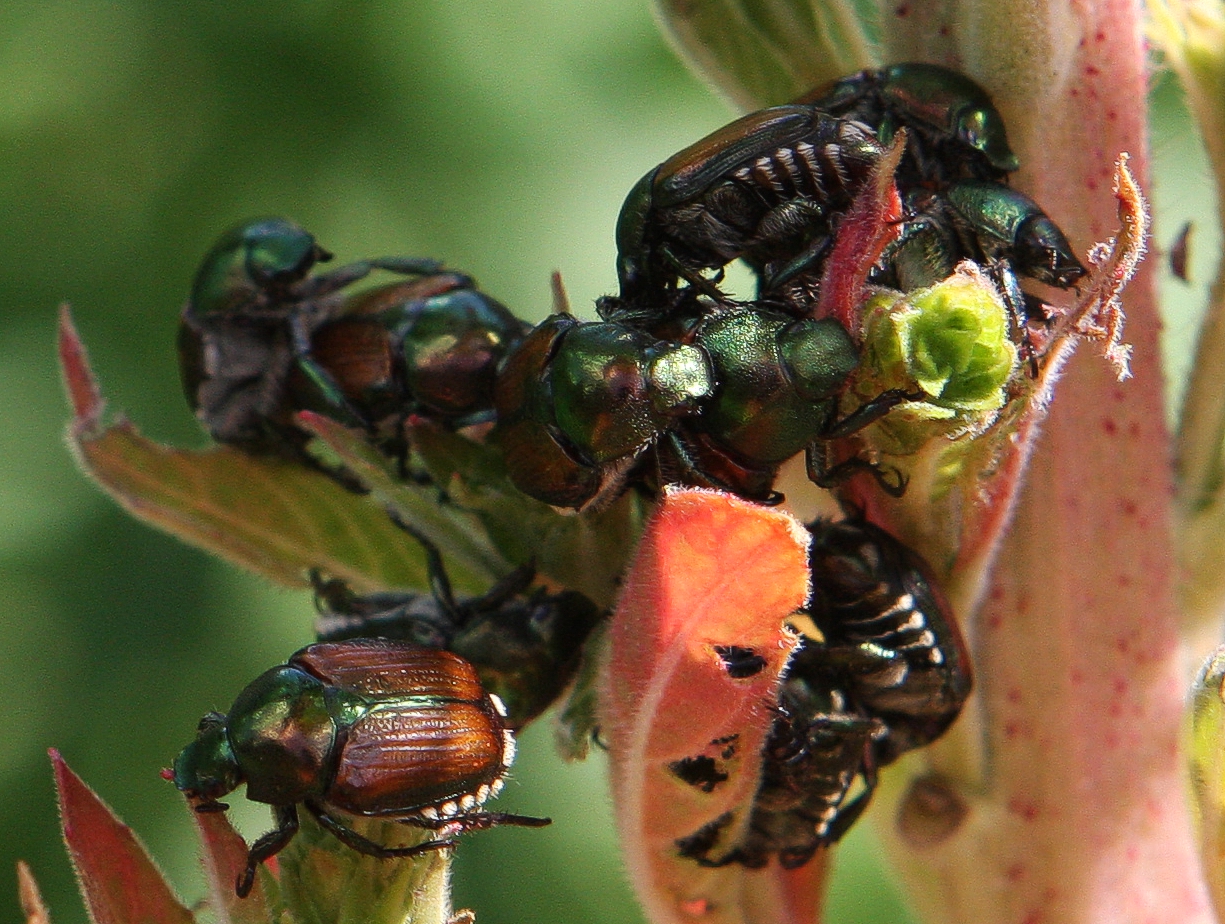
Adults fly in full sun from June to September, with a peak in July — exactly the window of the Pont capture. They feed during the day and often cluster in large numbers on a single leaf or fruit, a gregarious behaviour that our European chafers do not show.
More than 300 host plants, from vines to roses
The insect is tiny and harmless to humans (it does not sting, bite or transmit disease), but its damage potential is considerable: it is extremely polyphagous, with more than 300 recorded host plants. Among those most relevant in France:
- Vines, a major economic issue in Bourgogne-Franche-Comté (Côte-d'Or is the heart of the Burgundy vineyard).
- Fruit trees: apple, plum, cherry, peach, apricot.
- Soft fruit: strawberry, raspberry, blueberry, grape.
- Maize, soya and sunflower, a risk for arable crops.
- Ornamentals: linden, maple, horse chestnut, plane tree, rose, lilac, wisteria.
- Lawns and turf, where the grubs (white grubs) attack roots in autumn and winter.
The adult defoliates the aerial parts within days: a linden leaf can be fully "skeletonised" by a group of 30 to 50 adults in under a week. The damage is comparable to that caused by the Western corn rootworm or, more dramatically, by some processionary caterpillars — see our dossier on oak processionary caterpillars, the other summer 2026 pest to understand the mechanics of heat-driven outbreaks.
Why the Pont detection is worrying
Three factors make the 7 July 2026 capture particularly concerning:
- Geographic location: Pont (21130) sits right next to the A31 motorway, a major axis linking Burgundy to Lorraine and Luxembourg. A "hitchhiking" beetle can be transported several hundred kilometres in just a few hours.
- Wine-growing context: Côte-d'Or is France's leading département by area of appellation vines. A lasting establishment of Popillia japonica could jeopardise up to 30 % of the harvest on the most exposed plots, according to Italian feedback.
- Recent history: the first French detection in Haut-Rhin in 2025, followed by Écot on 16 June 2026, trace a north-westerly progression that mirrors the dynamic observed in northern Italy between 2014 and 2020.
For all these reasons, the DRAAF Bourgogne-Franche-Comté has triggered an immediate reinforcement of trapping (pheromone traps and food-baited traps) in the communes within a 5 km radius of Pont, as well as a survey scheme along road and rail corridors.