Introduction: the infestation doesn't start in your kitchen
When a resident calls a technician about cockroaches in the kitchen or rodent droppings behind the washing machine, the question to ask is almost never "how long has this been going on?" but "what's underneath your feet?".
In a shared residential building, the basement is a complete ecosystem: a stable temperature all year round, permanent darkness, damp, abandoned food, stacked cardboard boxes, and a web of service ducts linking every stairwell vertically. A rat that gets in through a faulty pipe joint on level -1 can reach the sixth floor without ever passing through a front door.
That's why so many in-flat treatments fail. You treat the symptom upstairs while the population reservoir stays intact twenty metres below. Three weeks later, recolonisation is complete.
This guide explains what actually goes on in cellars, lock-up garages, car parks and bin rooms, how to inspect them without being a professional, what the block management must cover, and the actions that produce a measurable effect.

Why the basement is a pest magnet
An underground space brings together, all at once, the four conditions any commensal species is looking for.
| Condition | What the basement offers | Species most concerned |
|---|---|---|
| Stable temperature | 12 to 18 °C year-round, no frost, no heatwave | German cockroach, oriental cockroach |
| Damp | Condensation on pipework, rising damp, no ventilation | Oriental cockroach, woodlouse, silverfish |
| Food | Bin room, bags left outside the containers, food stored in cellars, pet kibble | Brown rat, house mouse |
| Shelter | Cardboard, textiles, stored furniture, car park suspended ceilings | Mice, clothes moths, bed bugs |
In its work on commensal rodents, ANSES regularly points out that the brown rat (Rattus norvegicus) is a burrowing species that favours lower levels and sewer networks, while the house mouse is more inclined to colonise intermediate volumes. In practice: the rat comes from below, the mouse moves horizontally.
Add to that a frequently underestimated point: the basement is the only part of the building that nobody keeps an eye on. A resident goes down to the cellar four to six times a year. An infestation therefore has several months' head start before anyone notices.
The ten-minute inspection, torch in hand
A proper check doesn't require professional equipment. It requires light and a bit of method. The original cellar lighting — often on a timer and yellowish — hides precisely the clues you're looking for: a powerful rechargeable LED torch completely transforms the quality of the inspection, especially around skirting corners and under stairways.
Signs of rodents
- Droppings: brown rat droppings measure 15 to 20 mm and are spindle-shaped; mouse droppings are 3 to 6 mm, like a black grain of rice. Fresh ones are shiny and soft; older ones are dry and grey.
- Grease marks: dark, polished smears along walls, 3–5 cm above the floor, indicate a regular run. It's the most reliable clue for mapping a route.
- Gnawing: wooden door edges, electrical conduits, pipe insulation, plastic bags.
- Smell: a persistent ammonia note betrays accumulated urine, meaning an established colony rather than a passing individual.
Signs of cockroaches
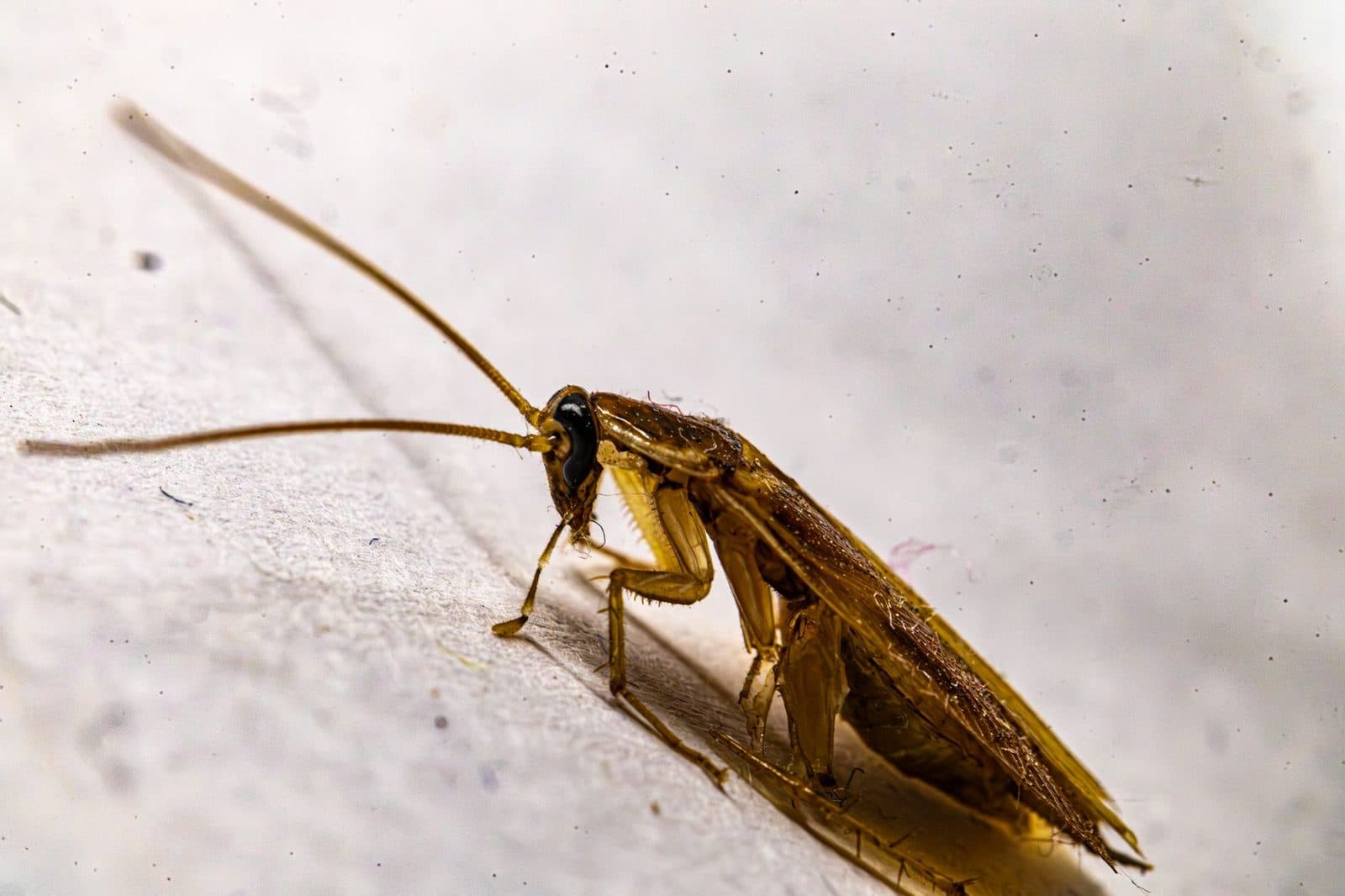
- Small black droppings, like scattered pepper, around consumer units and pipe penetrations.
- Empty oothecae — brown capsules 6 to 9 mm long — in cracks.
- A distinctive smell, sweetish and greasy, noticeable as soon as a population exceeds a few hundred individuals.
- Daytime sightings: a cockroach visible in broad daylight signals a saturated population, not the beginning of one.
Signs of textile damage
In cellars used to store clothes, rugs and spare bedding, the clothes moth (Tineola bisselliella) thrives. Look for silky cocoons in folds, small irregular holes in wool and cashmere, and whitish larvae at the bottom of boxes.
Mapping entry points: the vertical logic
A block of flats isn't a sum of apartments, it's a volume criss-crossed by networks. Pests use those networks.
The six critical routes
- Service ducts: vertical shafts grouping water supply, waste pipes and sometimes electricity. A single unsealed hole between two levels creates a motorway. It's the number one vector for German cockroaches in apartment buildings.
- Pipe penetrations in below-ground walls: the original seal degrades within ten to twenty years. A remaining 2 cm gap is enough for a mouse; 6 cm is enough for a brown rat.
- Inspection chambers and floor gullies: a cellar gully whose water trap has evaporated becomes a door left wide open onto the sewer network.
- Car park doors: the gap under the door leaf, often 3 to 5 cm, is crossed without difficulty.
- Low-level ventilation grilles that are damaged or torn off.
- Bin rooms: a door that no longer closes, containers without lids, a decommissioned rubbish chute poorly sealed off.
A practical rule technicians go by: a rodent gets through anywhere its skull fits. A mouse squeezes through a 6 mm gap, a young brown rat through 20 mm.
Sealing properly means using materials the rodent can't work through. Expanding foam on its own doesn't hold — it's gnawed away within a few nights. The proven solution is still metal mesh or packed stainless steel wool, then covered with a repair mortar. A roll of stainless steel wool costs a few euros and permanently settles a dozen or so holes.
What the block management must cover
The question of who pays comes up in every case. Cellars, car parks, bin rooms, service ducts and crawl spaces are common parts within the meaning of the French law of 10 July 1965. Their upkeep and sanitary condition therefore fall to the owners' association, funded through service charges.
Three texts frame the subject:
- The model Departmental Sanitary Regulation (circular of 9 August 1978) requires the owner to keep premises free of rodents and insects, and to carry out any necessary rat and insect control operations.
- Decree no. 2002-120 on decent housing, amended by the ELAN law, requires a dwelling to be "free from any infestation of pest and parasitic species".
- The Public Health Code (articles L.1311-1 et seq.) allows the mayor or prefect to order works where public health is compromised.
In practice, the most commonly applied split is:
| Situation | Usual responsibility |
|---|---|
| Rats in the car park, shared cellars or ducts | Owners' association |
| Cockroaches travelling up a shared waste stack | Owners' association (collective treatment) |
| Cockroaches confined to a single unit, with no shared source identified | Occupant of the unit |
| Cluttered private cellar acting as a source | Owner or tenant of the unit |
| Damaged bin room, faulty door | Owners' association |
For a deeper look at the split of responsibilities between landlord, tenant and managing agent, see our dedicated guide: pests in blocks of flats and rented housing, who pays for what.
One decisive legal point: a flat-by-flat treatment has no curative value if the source is shared. Asking the managing agent for a comprehensive intervention on a whole stack — all vertically aligned units treated on the same day — is not an excessive demand, it's the only technically valid method against the German cockroach.