Introduction: you're not fighting an ant, you're fighting an address
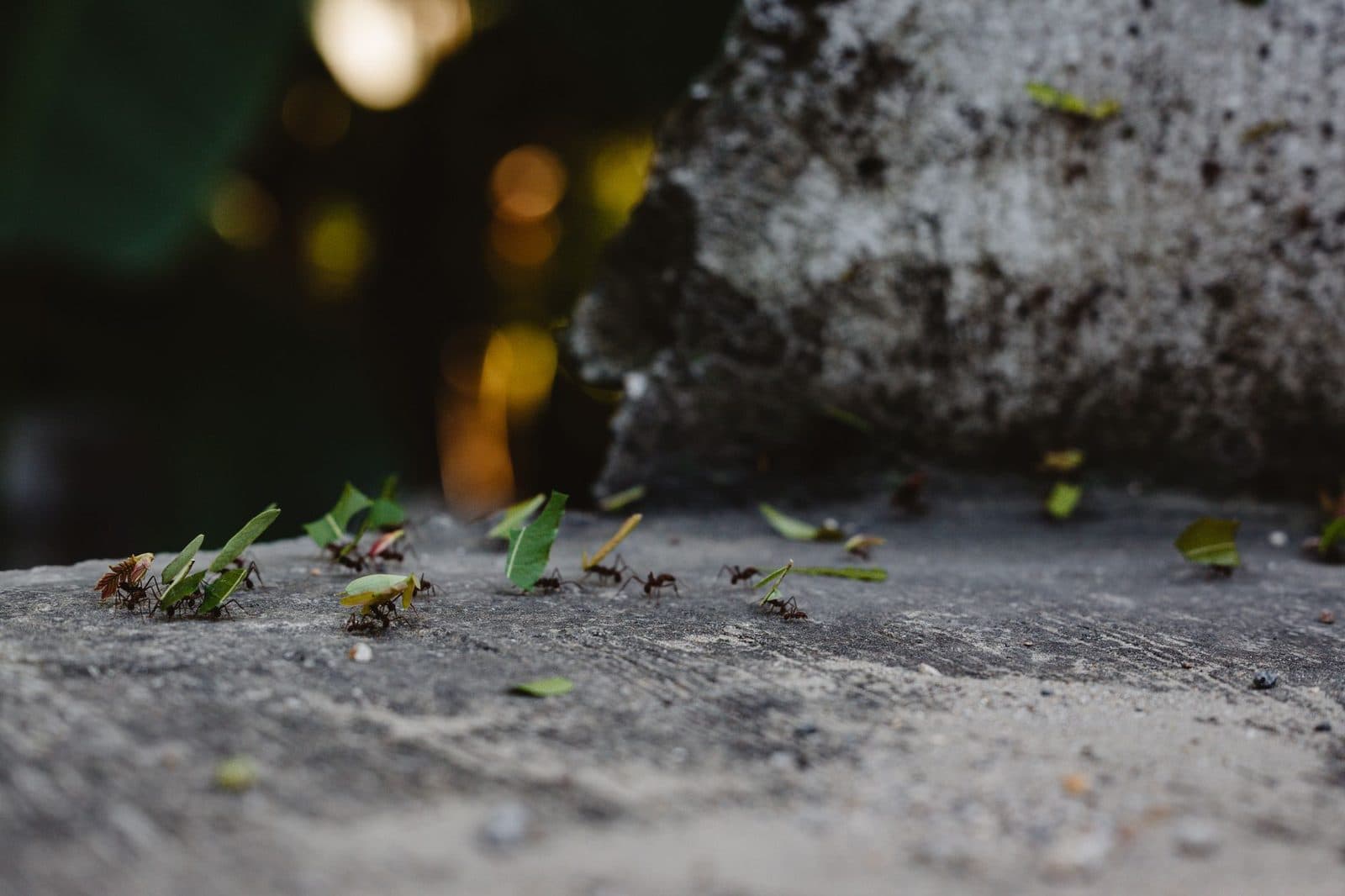
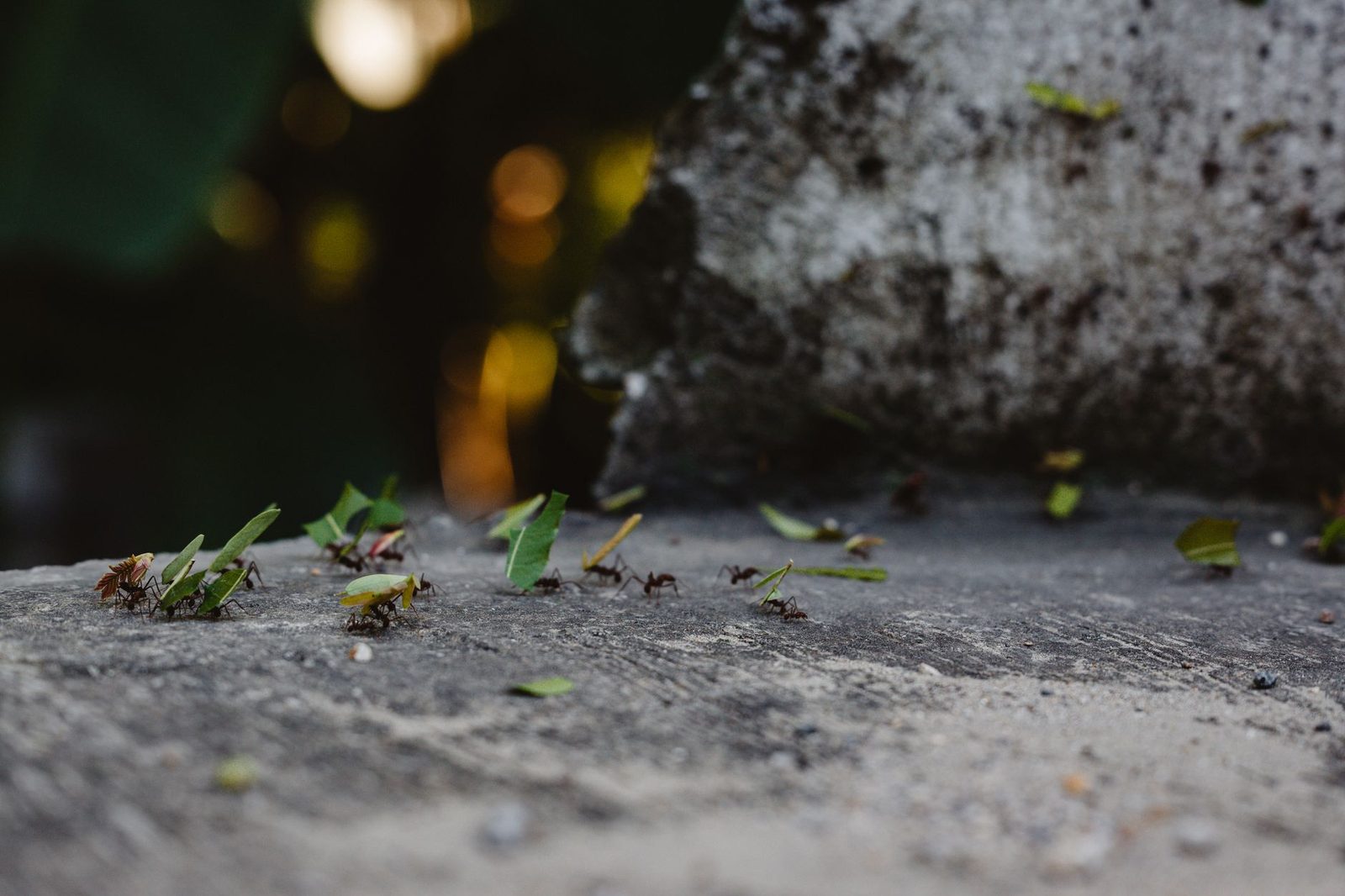
You come home in the evening, switch on the kitchen light, and a perfectly straight black line crosses the worktop: from the join in the tiles to the cat's bowl, or to the crumb of brioche that fell that morning. You clean, you crush, you spray. The next day, the same line is back, shifted ten centimetres over.
That's the experience reported by thousands of households this summer: several regional outlets, including Actu.fr, relayed accounts in July 2026 of massive ant infestations in the home all over France, and TF1 Info even ran a piece on tenants' rights in the event of an infestation. There's nothing mysterious about the phenomenon: a wet spring followed by a dry summer drives colonies to look for water and sugars inside buildings.
The problem is that almost every household treatment targets the visible workers, which represent a tiny fraction of the colony and are, from the anthill's point of view, an expendable consumable. As long as the queen keeps laying, the line comes back. This guide explains how to flip the logic: stop killing what you can see, and instead have the workers carry the poison to the heart of the nest.
Identifying the species: three very different profiles behind your baseboards
In mainland France, three species account for the vast majority of reports in homes. They are not treated the same way, and mistaking the first two for the third makes the infestation worse.
| Species | Appearance | Typical nest | Attracted to | Difficulty |
|---|
| Black garden ant (Lasius niger) | 3–5 mm, matt brown-black | Outdoors: patio, paving slab, base of wall | Sugars, aphid honeydew | Moderate |
| Pavement ant (Tetramorium sp.) | 2.5–4 mm, dark brown, grooved head | Under paving, thresholds, slab joints | Sugars and fats | Moderate |
| Pharaoh ant (Monomorium pharaonis) | 1.5–2 mm, translucent amber-yellow | Heated interiors: conduits, insulation, partition walls | Proteins and sugars alternately | High |
The pharaoh ant deserves a special mention. A tropical species acclimatised to heated buildings, it is regularly reported in hospitals, care homes, apartment blocks and retirement residences. Its distinctive trait: it practises budding. Faced with chemical stress — a spray of contact insecticide, typically — the colony splits into several satellites, each taking fertilised queens with it. You go from one nest to five. This is why, when very small yellowish ants are present inside a building, you must never spray: only baiting is acceptable.
Doubts about identification are common. A magnifying pocket loupe lets you check the number of segments in the antennal club and whether or not the thoracic notch is present — two criteria that separate Lasius from Monomorium in ten seconds.
Carpenter ants: the case that changes everything
If you see black ants 6 to 12 mm long, along with small piles of fine sawdust (known as "frass") at the foot of a wooden post or beam, you may be dealing with an ant of the Camponotus genus. It doesn't eat the wood — unlike termites — but tunnels smooth galleries into it to house its colony, preferably in wood already dampened by a leak or a thermal bridge. Here the issue is no longer the ant but structural damp: you have to find the water ingress before any treatment.
Why the insecticide spray doesn't work (and often makes things worse)
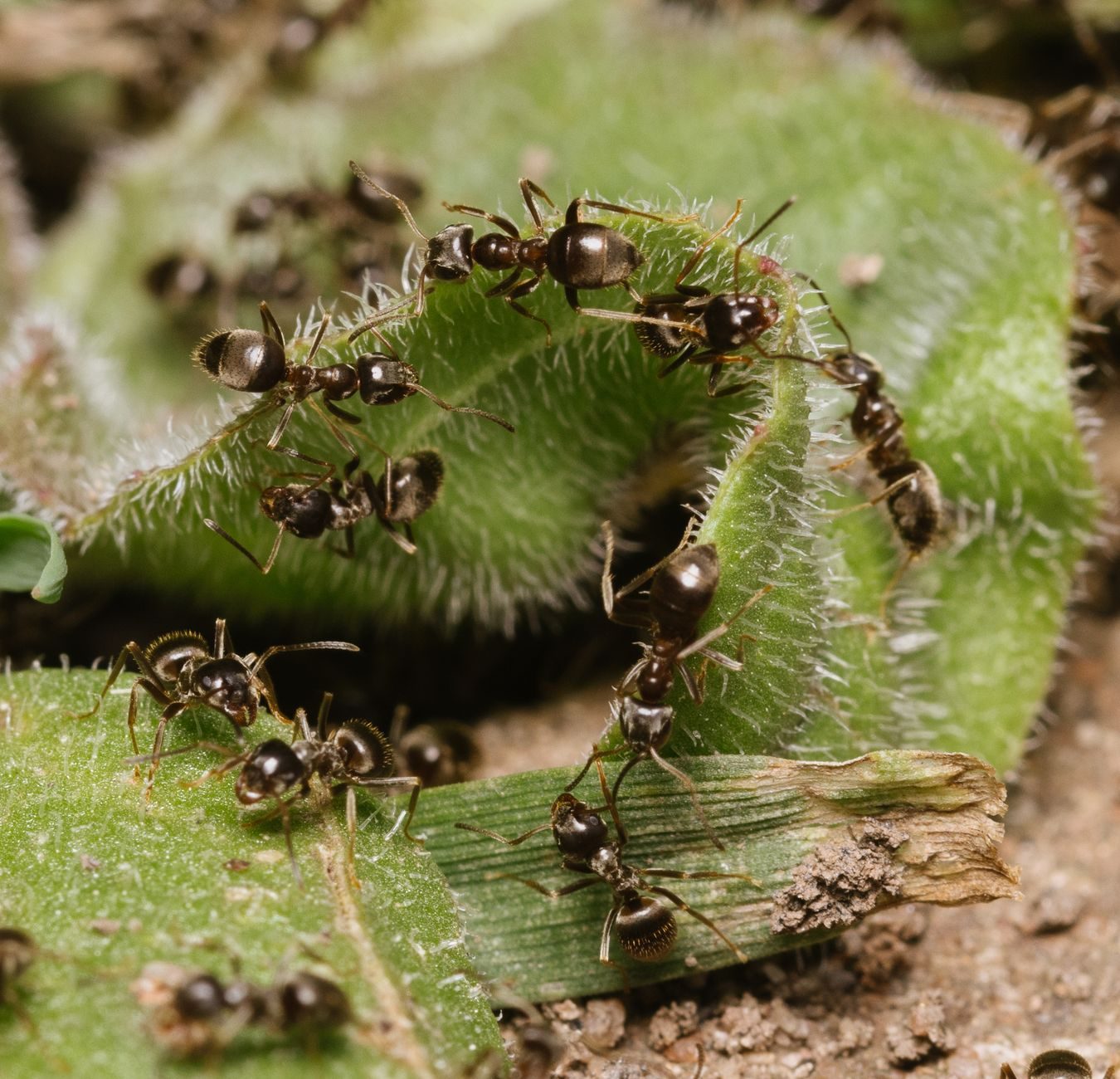
An adult Lasius niger colony numbers between 5,000 and 15,000 workers. At any given moment, fewer than 10% are foraging outside the nest; the rest tend the brood, the queen and the food stores. Crushing twenty ants on a worktop, or wiping out two hundred with an aerosol, therefore changes nothing about the nest's demographics.
Worse still, contact insecticide leaves a repellent film on the treated surfaces. The workers, which advance by following pheromone traces laid on the ground, simply skirt around the zone and open a new route — often less accessible, behind a baseboard or inside a service duct. You lose sight of the route, and with it the chance to bait in the right place.
Basic rule: as long as the trail is visible, it can be exploited. A line of ants is a motorway leading straight to the nest — destroy it and you lose your GPS.
ANSES, which assesses biocidal products placed on the French market, also points out that household aerosol insecticides needlessly expose occupants, particularly through inhalation in poorly ventilated rooms. For zero result on the colony, the risk/benefit trade-off is a bad one.
The four-step protocol that actually works
Step 1 — Map before you act (48 hours)
Don't clean anything for two days, unless hygiene makes it unavoidable. Observe:
- Where the trail comes in: window seal, pipe run under the sink, patio door threshold, crack in a baseboard.
- What time it is densest (often early morning and late afternoon).
- What it is carrying: sugary droplets visible in the translucent abdomen, or solid fragments (crumbs, dead insects) — this tells you whether the colony is in its "sugar" phase or its "protein" phase.
This information governs everything else. A colony in its protein phase will ignore a sugary gel, and you'll wrongly conclude that "the bait doesn't work".
Step 2 — Bait, don't spray
Bait works because it exploits trophallaxis: the worker ingests the gel, returns to the nest, and regurgitates it to feed its sisters, the brood and the queen. The active ingredient must therefore be slow — a fast-acting poison would kill the carrier before redistribution.
The household formulations available in France are mainly based on:
- boric acid / borax (0.5 to 1% in gel): digestive action delayed by 24 to 72 hours;
- fipronil (0.03 to 0.05%): highly effective, to be reserved for sealed bait stations;
- imidacloprid: delayed action, often in ready-to-use gel form.
In practice, an ant bait gel syringe applied in small drops the size of a grain of rice, directly on the trail and not beside it, gives the best results. Allow 4 to 6 points per affected room. In homes with children or pets, opt for sealed bait stations placed behind furniture and under the sink.
Three classic mistakes to avoid:
- Cleaning around the bait with a scented product: detergent wipes out the recruitment pheromones and the bait is no longer found.
- Using too much gel: a big blob dries into a crust and becomes inedible. Small and renewed beats large and one-off.
- Removing the bait as soon as it swarms: the phase when you see more ants, between day 2 and day 5, is the sign that recruitment is working. That's precisely the moment to leave everything alone.
Allow 7 to 21 days for a Lasius colony to collapse, and up to 6 to 10 weeks for a multi-nest pharaoh ant infestation.
Step 3 — Cut the trails and the resources
Alongside baiting — never instead of it — you need to strip the home of its appeal:
- Wipe out pheromones on the routes you don't want to keep: hot water with white vinegar, or a diluted ammonia solution. Do this well away from the bait points.
- Contain sugars: caster sugar, honey, syrups, kibble and pet bowls in airtight glass containers. The cat's bowl set in a saucer of water becomes an island they can't cross.
- Remove standing water: sink wiped dry in the evening, bath seal kept dry, houseplant saucers never left with water sitting in them.
- Close off access points: sanitary silicone sealant or an acrylic filler on pipe runs, baseboard cracks and gaps in window and door frames.
For more on the underlying habits that apply to all household pests, our prevention advice page and our shop selection detail the equipment that is genuinely useful.
Step 4 — Treat the outdoor source
For Lasius niger and pavement ants, the nest is almost always outside: under a patio slab, against the south-facing garden wall, in the planter pot. Three levers:
- Get rid of aphids on roses, lime trees and shrubs near the façade: their honeydew is the colony's main sugar fuel. A black soap insecticide applied as a foliar spray cuts off that resource.
- Clear a dry strip 30 to 50 cm wide at the foot of the walls: no thick mulch, no firewood stacked against the façade, no vegetation touching the cladding.
- Bait outdoors with water-resistant stations, placed along the route between the nest and the entry point.
Old wives' remedies: what holds up and what doesn't
| Method | Actual effect | Verdict |
|---|
| White vinegar | Erases pheromones, doesn't kill | Useful as a complement |
| Coffee grounds | No solid evidence of efficacy | Ineffective |
| Chalk / talc | Very temporary physical barrier | Anecdotal |
| Diatomaceous earth | Abrasive, dehydrates; inactive as soon as it gets damp | Useful when dry, as a barrier |
| Essential oils (peppermint) | Short-lived repellent, needs reapplying | Diverts, doesn't solve |
| Boiling water on the anthill | Kills part of the surface brood | Partial, the queen often survives |
Food-grade diatomaceous earth is worth knowing about: applied in a thin layer behind kitchen units, in crawl spaces or under baseboards — that is, in dry areas away from foot traffic — it damages the insects' cuticle and causes desiccation. It is, however, completely useless in a damp spot and must be handled with a mask, as the dust irritates the airways.
Ants and housing: tenant, landlord, who pays?
The question was popularised by the piece broadcast by TF1 Info in July 2026. The framework is decree no. 2002-120 on decent housing, which requires a dwelling to be free of any infestation by pest and parasitic species, together with the law of 6 July 1989.
In practice:
- Routine upkeep (cleaning, food management, occasional baiting) falls to the tenant.
- A structural infestation — linked to a crack in the façade, failing waterproofing, chronic damp, or affecting several dwellings in the same building — falls to the landlord or the building's co-ownership via the common areas.
- The procedure: written report, recorded delivery letter with acknowledgement of receipt, dated photos, then referral to the departmental conciliation commission if things stall. The municipal hygiene and health service (SCHS) or the ARS can be called on if the situation compromises sanitary conditions.
A rent reduction is never automatic: it requires either an amicable agreement or a ruling from the protection litigation judge, and the infestation must be documented. A log book with dates, photos and copies of correspondence carries far more weight than a verbal account.
Our article dedicated to pests in co-owned and rented properties sets out how costs are allocated for all species.
When to call a professional
A well-equipped householder will see off a black garden ant colony in the great majority of cases. Hand over when:
- you have identified pharaoh ants (very small, yellow, indoors, in an apartment block);
- the infestation affects several dwellings or common areas;
- you suspect carpenter ants in a timber structure;
- two full three-week baiting cycles have produced no measurable decline;
- the premises are sensitive: nursery, catering, care home, retirement residence.
A Certibiocide-certified applicator has access to professional non-repellent gels and active ingredients unavailable to the general public, and above all a written treatment plan with a follow-up visit. Expect to pay roughly €120 to €250 for treating a home with a follow-up visit. Our intervention services explain how a case is handled from start to finish.
Key takeaways
- Visible ants are less than 10% of the colony: killing them changes nothing.
- Never spray when pharaoh ants are present, or you risk multiplying nests through budding.
- Bait in small drops, placed on the trail, is the only method that reaches the queen.
- A temporary increase in the number of ants around the bait is the sign that it's working.
- The nest is often outdoors: aphids, mulch against the façade and cracks in paving are the real starting points.
- In rented accommodation, document everything in writing from the very first report.
A pest problem?
Our experts act fast and for good. Request a free assessment.
Request a free quoteOur services