Introduction: the nest nobody spotted all summer
An ordinary garden, an oak tree at the bottom of the plot, a hedge trimmed in June without the slightest incident. Then, one morning in late September, the first leaf falls — and there it is, seven metres off the ground: a grey sphere the size of a basketball. It was already there in July. The foliage simply hid it completely.
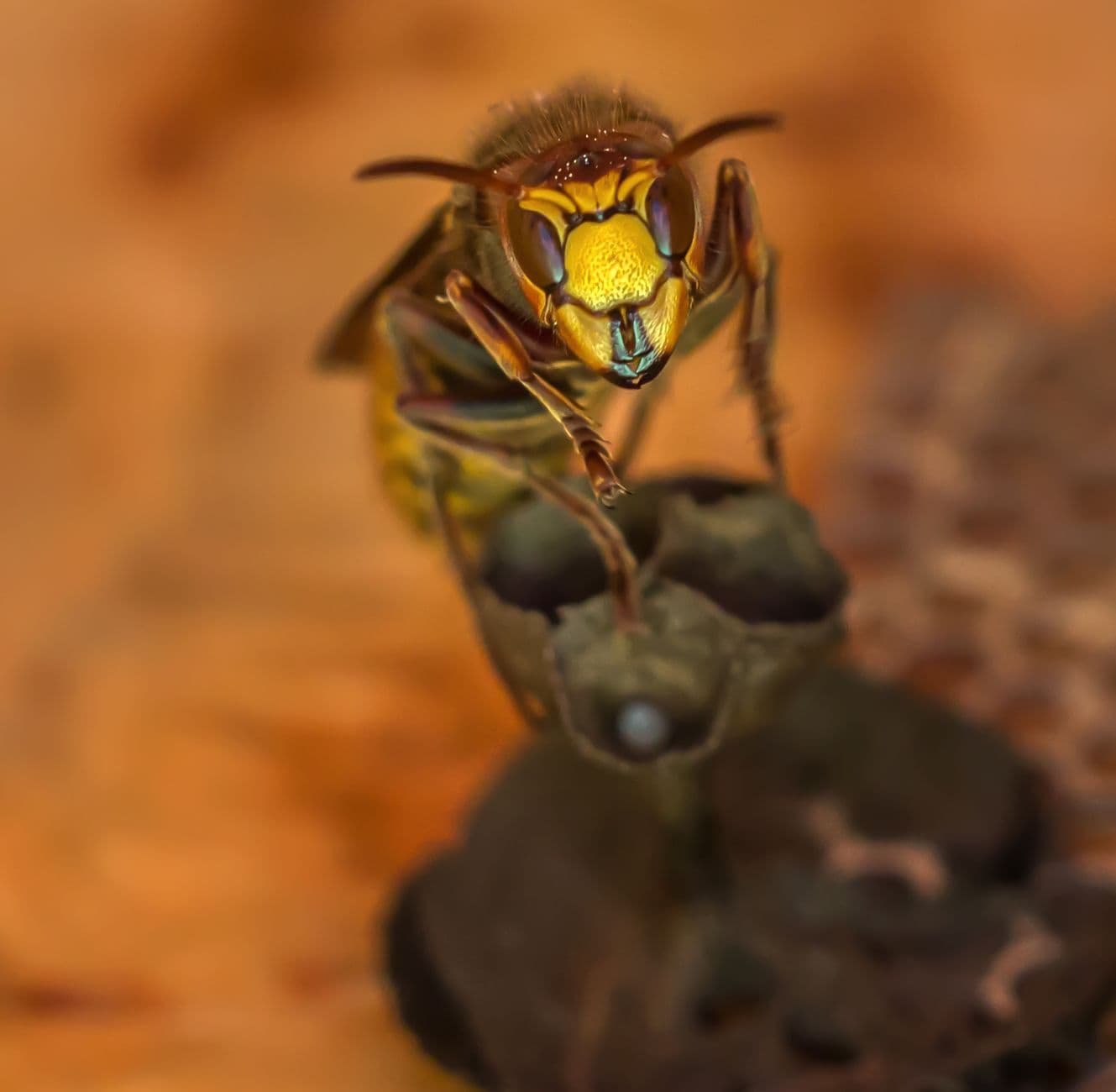
This is the most common scenario technicians encounter in autumn. The Asian hornet (Vespa velutina nigrithorax) doesn't become visible because it has just arrived, but because two things happen at once: the colony reaches its maximum headcount, and the trees begin to shed their leaves.
That double coincidence makes September and October the trickiest period of the year. Not the most dangerous in terms of the number of nests — those have been there since spring — but the riskiest in terms of accidental encounters between a human holding a chainsaw, a ladder or a hedge trimmer, and several thousand workers defending their brood.
This guide explains what actually happens inside a colony at this time of year, how to identify a secondary nest without going near it, what French law has provided for since 2025, and which measures genuinely hold up for a private individual.

The annual cycle: why everything comes to a head now
An Asian hornet colony is annual. It is founded by a single queen in spring and dies out entirely at the onset of winter. This point is crucial: it shapes the entire control strategy.
| Period | What's happening in the colony | What it means for you |
|---|---|---|
| February–April | The foundress emerges from hibernation and builds a primary nest the size of a golf ball, then an orange, often under cover (carport, shed, window recess) | Very easy to destroy, a single female |
| May–July | The first workers take over; the colony relocates to a secondary nest, usually high up | The nest grows out of sight |
| August–October | Maximum headcount: several thousand individuals in a large nest; production of future foundresses and males | Peak aggression and chance discoveries |
| November–December | The colony dies out, the young mated foundresses leave to overwinter alone | The empty nest will never be reoccupied |
Remember that last line: a nest found deserted in December or January poses no danger and will not be reused. Having it destroyed at that point is money wasted. Conversely, a nest still active in late August will remain intensely busy for another six to ten weeks, during which it will release its future queens into the neighbourhood.
How many future queens?
Work by INRAE and the Muséum national d'Histoire naturelle, which have been monitoring the species since its accidental introduction into Lot-et-Garonne in 2004, estimates that a mature nest can produce several hundred young foundresses. Only a tiny fraction will survive the winter and manage to found a viable colony — but the order of magnitude explains how quickly the species has colonised the country. It is now present in almost every mainland department.
Identifying the Asian hornet without getting it wrong
The costliest confusion — both financially and for biodiversity — remains the one with the European hornet (Vespa crabro), a native, beneficial and non-invasive species that there is no reason whatsoever to destroy when it threatens no one.
Asian hornet:
- Entirely black, velvety thorax
- Dark abdomen with a single broad orange band towards the tip
- Yellow leg tips — the most reliable feature at a distance, hence its nickname "yellow-legged hornet"
- Size: 17 to 32 mm depending on caste
- Does not fly at night and is not attracted to light
European hornet:
- Black and russet thorax
- Mostly yellow abdomen with black stripes
- Reddish-brown legs
- Larger (up to 35 mm)
- Flies at night and readily bumps against lit windows
A hornet tapping at your window at 11 p.m. in September is therefore, in the vast majority of cases, a European hornet — a species protected in some departments and best left alone. To settle the question without going closer, an insect identification guide for France or a simple pair of compact binoculars will serve you far better than a blurry photo taken at arm's length.
The nest, another diagnostic clue
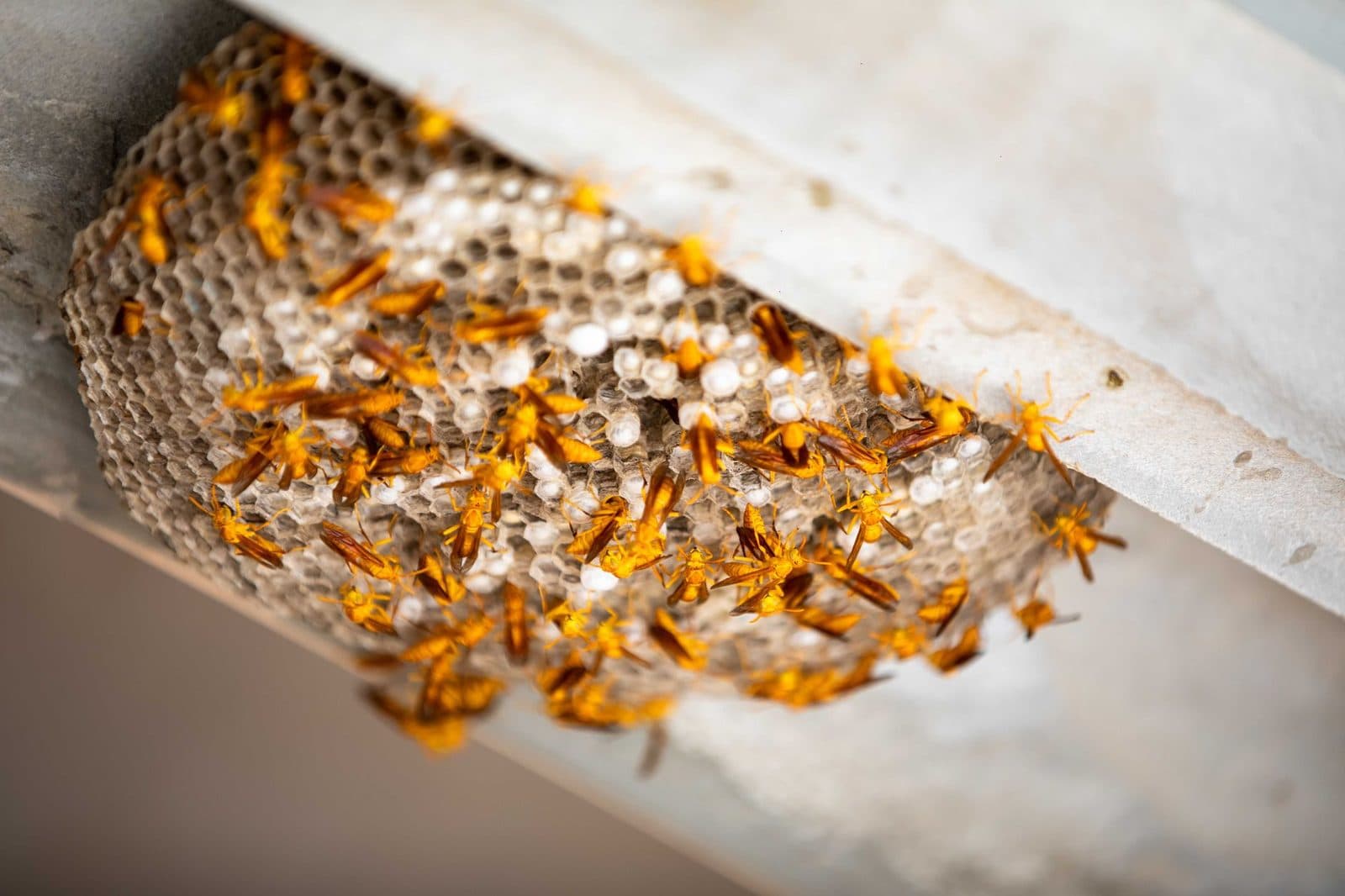
The Asian hornet's secondary nest is a sphere or pear shape made of beige-grey papier-mâché, up to 80 cm or 1 m tall, with a side entrance (not one underneath). It is most often located more than 10 metres up in a tree — but they are also found under roof overhangs, in dense hedges, sheds or bramble thickets.
The European hornet, by contrast, prefers cavities: hollow trunks, lofts, roller-shutter boxes, and its nest has an opening at the bottom.
Why aggression increases in autumn
The Asian hornet is not aggressive in itself. It does not hunt humans, does not defend its foraging territory, and you can walk within a metre of a worker catching a fly without the slightest risk.
Everything changes near the nest. The defence zone expands in autumn: where a few metres were enough in June, you should allow 5 to 10 metres around a large nest in September, and more still if you are generating vibrations. The most frequent triggers of a collective attack are mechanical:
- Hedge trimmer or brush cutter nearby
- Chainsaw or tree pruning
- Mower passing beneath the host tree
- Leaf blower
- A knock on the trunk, a ladder leaned against it
Vibration and noise are perceived as an attack on the nest. The response is collective and swift, and hornets can pursue for several dozen metres. Unlike a bee, a hornet does not lose its sting and can sting repeatedly.
What to do if you are attacked
Run away in a straight line, without waving your arms, heading for enclosed shelter: a house, a car, a shed. Never jump into water — the hornets will wait at the surface. Never try to swat an individual near the nest: the alarm pheromones released mobilise the entire colony.
Medically speaking, Ameli and Vidal point out that an isolated hornet sting, though extremely painful, is not dangerous for a non-allergic person. The venom is no more toxic than a wasp's; it is the volume injected that makes the difference. Situations warranting an immediate call to 15 or 112 are:
- a sting in the mouth, throat or near the eye;
- multiple stings (from around twenty in an adult, far fewer in a child);
- any sign of a generalised allergic reaction: widespread hives, facial swelling, difficulty breathing, faintness, vomiting.
People already known to be allergic to hymenoptera stings must carry their prescribed adrenaline auto-injector pen and know how to use it. For everything else, cold applied quickly brings relief: a reusable gel pack kept in the freezer is more than enough, and an antihistamine from the household medicine cabinet limits local swelling.