Introduction: the month the colony peaks
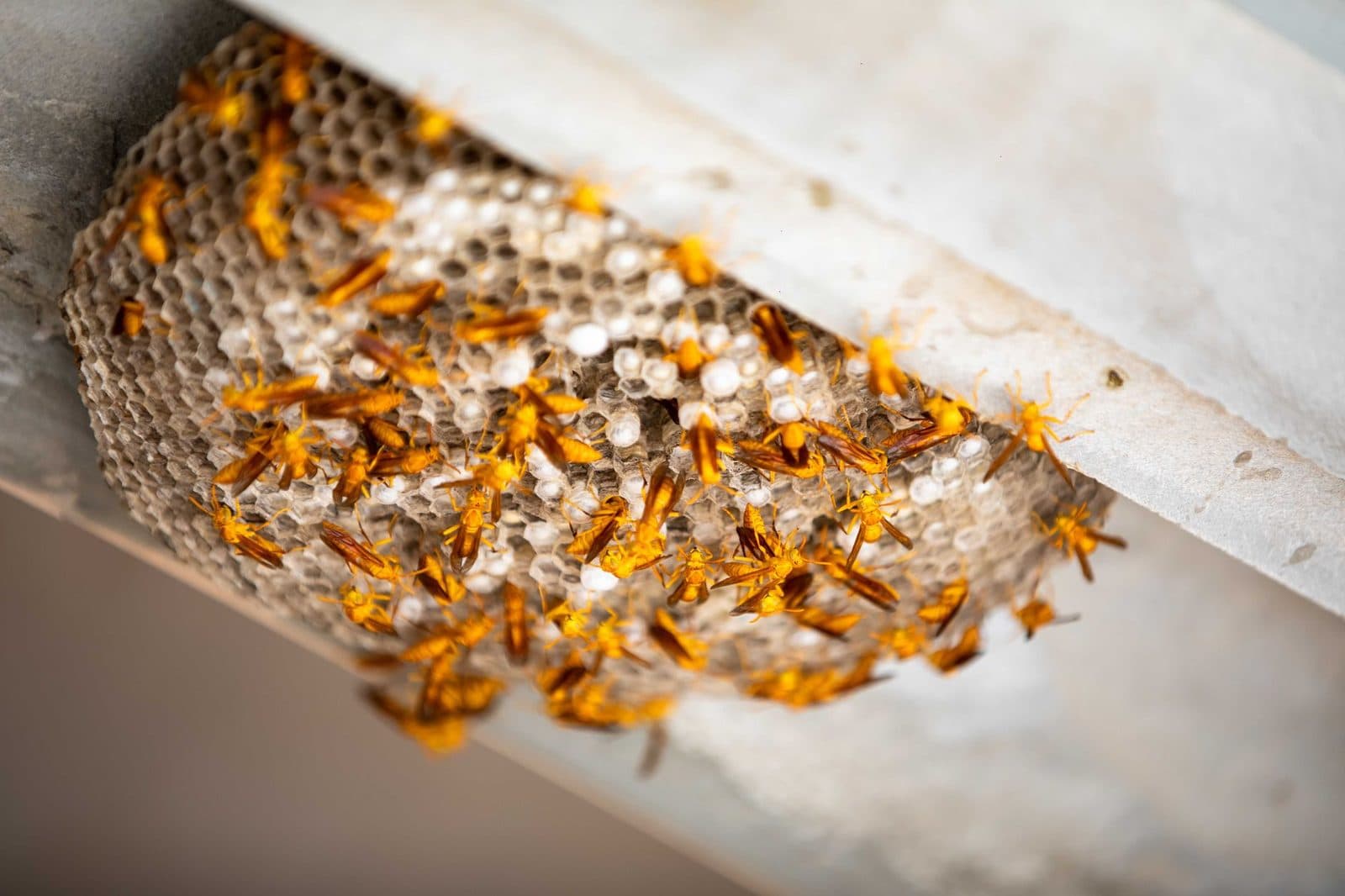
There is a pattern every pest-control operator knows by heart: the phone barely rings in May, picks up a little in June, and is jammed solid from mid-August to late September. This has nothing to do with the calendar or the holiday season. It is pure biology: a common wasp colony (Vespula vulgaris, Vespula germanica) starts in spring with a single queen and peaks in late summer with several thousand individuals. The nest nobody noticed in June under a roof overhang has become, by August, a structure the size of a rugby ball with a constant stream of workers pouring in and out.
On top of this population explosion comes a behavioural shift. Late in the season, the queen stops laying worker larvae. Those larvae were the ones that, in exchange for the protein brought in by the workers, secreted a droplet of sugary liquid the adults prized. Deprived of that reward, the workers go looking for sugar elsewhere — fallen fruit, drinks cans, café tables — and their tolerance threshold collapses. This is the time of year when people get stung.
The point of this guide is not to alarm anyone: the vast majority of nests sited well away from foot traffic can simply be left alone until they die out naturally. The point is knowing which one needs treating, which one can be ignored, and how to avoid turning a nuisance into an accident.
Understanding the cycle: why it all comes to a head now
From a lone queen to a colony of thousands
The timeline of a social wasp colony in mainland France follows a fairly stable pattern, shifted by a few weeks depending on latitude and how mild the spring has been.
| Period | Colony stage | What you see |
|---|---|---|
| March–April | The queen emerges from hibernation and builds a walnut-sized nest single-handedly | A lone wasp exploring a shelter, a shed, a roller-shutter housing |
| May–June | First workers, nest the size of a tennis ball | A few discreet comings and goings, usually unnoticed |
| July | Exponential growth, several hundred workers | Steady traffic towards one specific point on the façade |
| August–September | Peak numbers, production of reproductives (future queens and males) | Bulky nest, non-stop activity, wasps very present at the table |
| October–November | Decline, colony death, only mated young queens hibernate | Abandoned nest, sluggish wasps |
One essential conclusion follows: a wasp nest is never reoccupied the following year. Once the colony dies at the first frosts, the papier-mâché structure stays empty. Destroying an empty nest in November therefore serves no public-health purpose — unless it is physically in the way, for instance in a flue or behind cladding, where it will eventually break down and attract keratin-feeding insects.
The Asian hornet runs on a different schedule
Vespa velutina follows the same logic but with one quirk that explains why nests are found so late: the colony founds a primary nest in spring, often low down and sheltered (garden shed, under an overhang, inside a hedge), then relocates in early summer to a secondary nest, frequently 10 to 15 metres up a tree. That secondary nest usually goes unnoticed until September or October, when leaf fall reveals it. The Muséum national d'Histoire naturelle, which has coordinated reporting of the species since it arrived in France in 2004, points out that peak production of future founding queens occurs precisely in autumn — hence the value of destroying a nest before they disperse.
Identify the species before making any decision
Many unnecessary call-outs involve protected or entirely harmless insects. A careful look avoids a costly mistake.
Common wasps
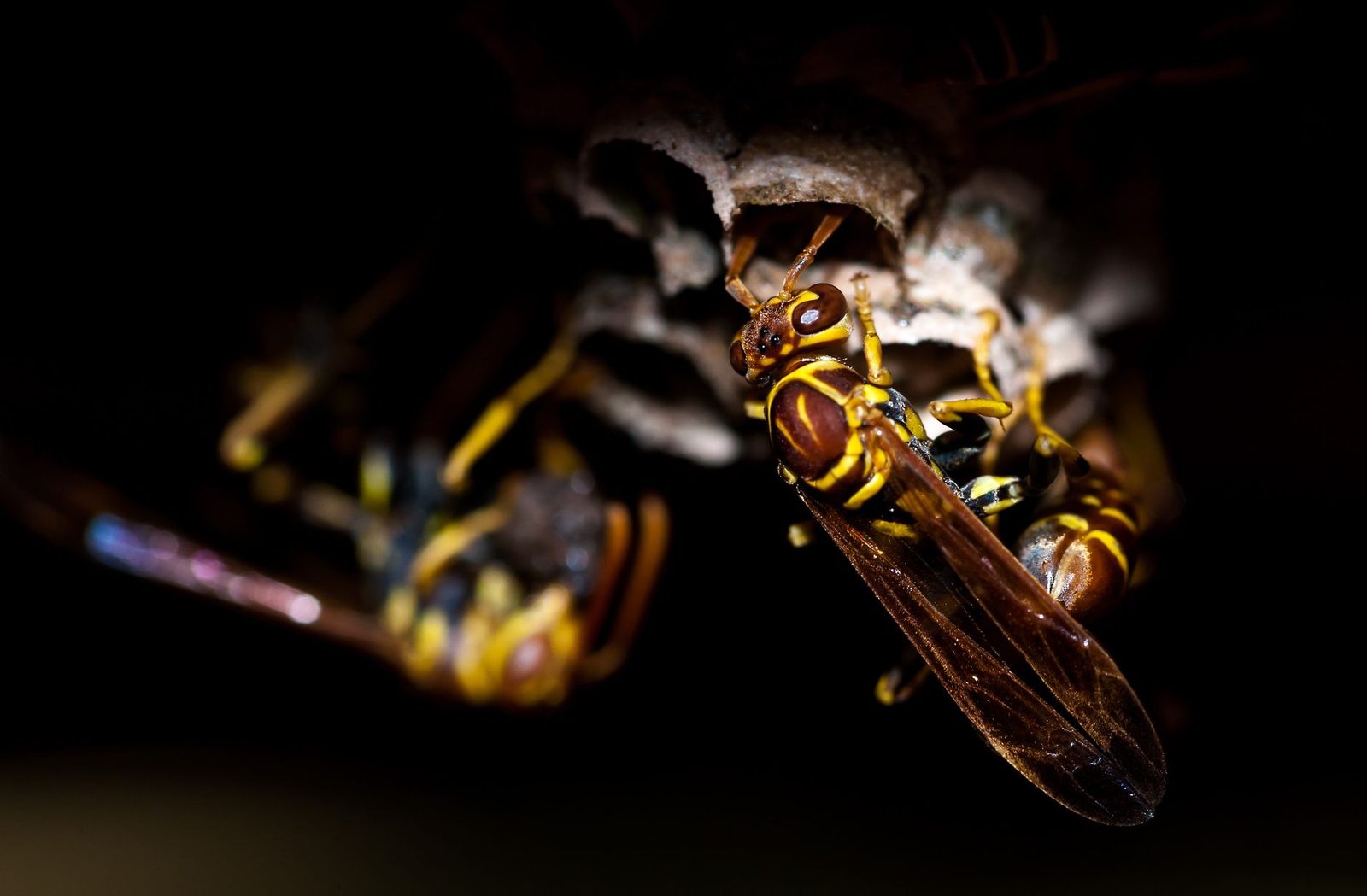
Short, stocky body, bright yellow banded with black, very pronounced waist, jittery flight. They build nests of grey papier-mâché (chewed wood), either aerial (loft, shelter, roof overhang) or underground in an old vole burrow. These are the ones that land on plates and sweet drinks.
The European hornet (Vespa crabro)
Much larger (up to 35 mm), with reddish-brown and yellow tones. Impressive, but far less aggressive than its reputation suggests. It hunts at night and is drawn to lights. It is not protected at national level, but it renders genuine services by keeping flies and caterpillars in check: a nest at the bottom of a garden, away from foot traffic, deserves to be left in place.
The Asian hornet (Vespa velutina nigrithorax)
Slightly smaller than the European species, with a matt black thorax, dark abdomen ringed by a broad orange band, and yellow leg tips — the most reliable identifier from a distance. A predator of honeybees, it is the subject of a national control plan. It is no more dangerous to humans than a European hornet with comparable venom, but it defends its nest over a wider radius, on the order of 5 metres.
Mistaken identities
- Honeybees: hairy, golden-brown body, swarm hanging in a compact cluster. A swarm is not destroyed, it is collected — a local beekeeper or the nearest beekeeping association will usually take it away free of charge.
- Bumblebees: large, very hairy, colonies of a few dozen individuals, dying out naturally in August. No reason to intervene.
- Solitary and paper wasps (Polistes, mason wasps): Polistes build a small umbrella-shaped nest with no outer envelope, rarely more than 30 individuals, and sting very little.
Locating the nest without going near it
The method is simple and risk-free: stand at least 10 metres away, ideally in late afternoon when traffic is heaviest, and follow the insects' flight path with binoculars. The comings and goings always converge on a single entry point. A pair of compact binoculars is more than enough and saves you from pressing your eye up to an opening — a move that almost always triggers a defensive response.
The most common locations in French homes:
- under verge tiles and in uninsulated lofts;
- behind roller-shutter housings (one of the most troublesome cases, as the nest grows on the inside);
- in disused chimneys and ventilation ducts;
- under a wooden deck or in an embankment, for ground-nesting species;
- in dense laurel or thuja hedges, at waist height.
One signal never to ignore: a continuous, dry rustling sound audible through a partition wall or ceiling. It indicates a colony already well established inside the structure, not simply insects passing through.
Should you intervene? An honest decision framework
Not every nest justifies destruction. Here are the criteria that, in practice, tip the balance.
Intervention recommended:
- nest less than 5 metres from a door, a regularly opened window, a terrace or a play area;
- nest within the living space (converted loft, shutter housing, service duct);
- a household member with a known allergy to hymenoptera venom;
- underground nest on mown or frequently used ground: mower vibrations trigger mass attacks;
- Asian hornet nest near beehives or a thoroughfare.
Reasonable to leave alone:
- nest high in a tree at the far end of a plot, with no foot traffic within 10 metres;
- isolated European hornet nest;
- nest discovered after mid-October: the colony is at the end of its life, the frosts will do the job;
- honeybee swarm or bumblebee colony.