
Door Bottoms and Thresholds: A Home's No.1 Weak Point

· Published on · 11 min read
Pile of bin bags, rubbish and cans heaped against a bike-share bicycle on a pavement

"We got someone in for the cellar, for the loft, we put wire mesh everywhere. And then the technician slid a sheet of paper under the garage door, turned off the light, and we could see daylight. He told me: your mouse isn't ringing the bell, she's coming in right there." This homeowner in Champigny-sur-Marne had inspected his whole house except the one spot he himself walks through ten times a day.

It is one of the most consistent findings on house call-outs: the main entry point for rodents is almost never a hole in a wall, it's the bottom of a door. A door is a moving part, exposed to knocks, frost, threshold settlement and seal wear. Sooner or later it stops touching the floor along its full length. And one time out of two, that is already enough.

This blog has already covered the materials that actually hold when plugging a hole, cellar air vents and the garden shed and the unheated garage. This article deals with one very specific and badly underrated piece of building detail: thresholds, door bottoms, sliding patio doors and cat flaps — how to measure the gap, how to close it, and what won't last three months.

Pile of bin bags, rubbish and cans heaped against a bike-share bicycle on a pavement

How much space does a rodent need under a door?

The figures often get quoted loosely. Industry references and the prevention leaflets published by municipal public health departments stick to fairly stable orders of magnitude:

SpeciesGap it can get throughReal-world comparison
House mouse (Mus musculus)roughly 6 to 7 mmthe thickness of a pencil
Brown rat / sewer rat (Rattus norvegicus)roughly 20 mmthe width of a thumb
Wood mouseroughly 8 mma small coin standing on its edge

A mouse doesn't need to dig: its skull is the only rigid part of its body, everything else compresses. If the head fits, the animal fits. And a rodent enlarges whatever it already squeezes through: a 5 mm gap in a wooden door bottom becomes a 3 cm hole after a few nights of gnawing.

The test is instant, and it costs nothing. Close the door, switch off the light on the inside, and look from the other side in broad daylight: any sliver of visible light is a way in. For a dark garage, the reverse works too — put a lamp on the floor inside and look from outside after dark. Plenty of people do this check with nothing more than an electrician's tape measure slipped under the door; 8 mm speaks for itself straight away.

The four doors that let rodents into a house

1. The garage door, by far the biggest culprit

An up-and-over or sectional garage door is, by design, the least airtight part of the building. Its classic failings:

  • A hardened bottom seal. The rubber or EPDM bead cracks after eight to ten years, loses its elasticity and no longer makes contact. It still looks to be in place: that's exactly why nobody suspects it.
  • A hollowed or cracked concrete threshold. Sloping garage entrances, very common in houses in Saint-Maur or Nogent, wear away at the drainage channel. A dip 2 cm deep and 15 cm wide is enough for a brown rat.
  • The side corners. Even with a sound bottom seal, the door's two vertical corners almost always leave an open triangle.
  • Cable and conduit penetrations drilled later for a motor, a socket or an automatic watering system, and never sealed up again.

Replacing the seal is well within DIY reach: pull out the old one, clean the channel, and clip in a garage door bottom seal with the right profile (U-shaped, omega, clip-in or screw-fixed depending on the model). For an uneven threshold, a rubber threshold ramp bonded to the floor, which compensates for the dip, is a better bet than a thicker seal that will stop the door closing.

2. The side door and the back kitchen door

This is the door you take the bins out through, and it's also the one that gets the most use. Its bottom edge rubs, jams and drops. In many houses the original wooden or stone threshold has been covered with a screed or patio tiles: the door was planed down, and now it no longer touches anything over an inch or so.

Two options, and only one good one:

  • Avoid: expanding foam, polyurethane foam sprayed into the gap. A rodent goes straight through it in one night. It has no mechanical strength whatsoever.
  • Do this: a screw-fixed brush door bottom strip with a dense, long nylon brush, or better still, for an exposed door, an aluminium bar with a silicone seal. On a wooden door already attacked along its lower edge, best practice is to add a metal plate 20 to 30 cm high, screwed on from the outside: that's the only way to stop the edge being gnawed.

3. Patio doors and sliding glazed units

A sliding unit never closes airtight: the leaf runs in a track, and the track is open at its ends. It's a discreet motorway for mice, especially when the terrace is bordered by a planting bed or pots. Points to check:

  • The drainage holes in the track, on the outer face of the frame. They are essential for draining water away — you don't block them, you mesh them with a small piece of stainless steel wire cloth or a cut-down off-the-shelf ventilation grille.
  • The vertical brush seals between the two leaves, often crushed or missing.
  • The roller shutter above, whose box sometimes opens into the loft or the stud lining. That's a subject in its own right, but the instinct is the same: look for the gaps.

4. The cat flap

This is the most frustrating case, because the owner installed the opening on purpose. A simple swinging-flap cat flap is an open door to a rat: it just pushes through. A 350 g brown rat has far more than enough pushing force.

If the family pet needs to get out, the only defensible set-up is a microchip cat flap, which only unlocks for the cat's own ID chip. At the same time it solves another problem covered elsewhere on this blog: food bowls left outside. Failing that, a cat flap you can lock manually at night is better than nothing — rodent activity peaks from dusk until about two hours after sunset.

Why the gap opens up precisely in November

Three things come together in early autumn in the Val-de-Marne:

  1. Thermal contraction. A cold rubber seal loses suppleness and volume. A door that was perfectly sealed in August can leave a 4 to 5 mm gap in November, at -1 °C in the early morning.
  2. The warm air gradient. As soon as the heating is on, the bottom of a door becomes a source of smell and warmth detectable several metres away. A rodent isn't looking for a door: it's following a stream of warm air upwind.
  3. Population pressure. The late-summer litters are now adults. Young brown rats are driven out of the parental burrow and go looking for a new home. This is exactly the period described in our article on outdoor shelters in the garden: the animal starts off outside, then starts testing the building.

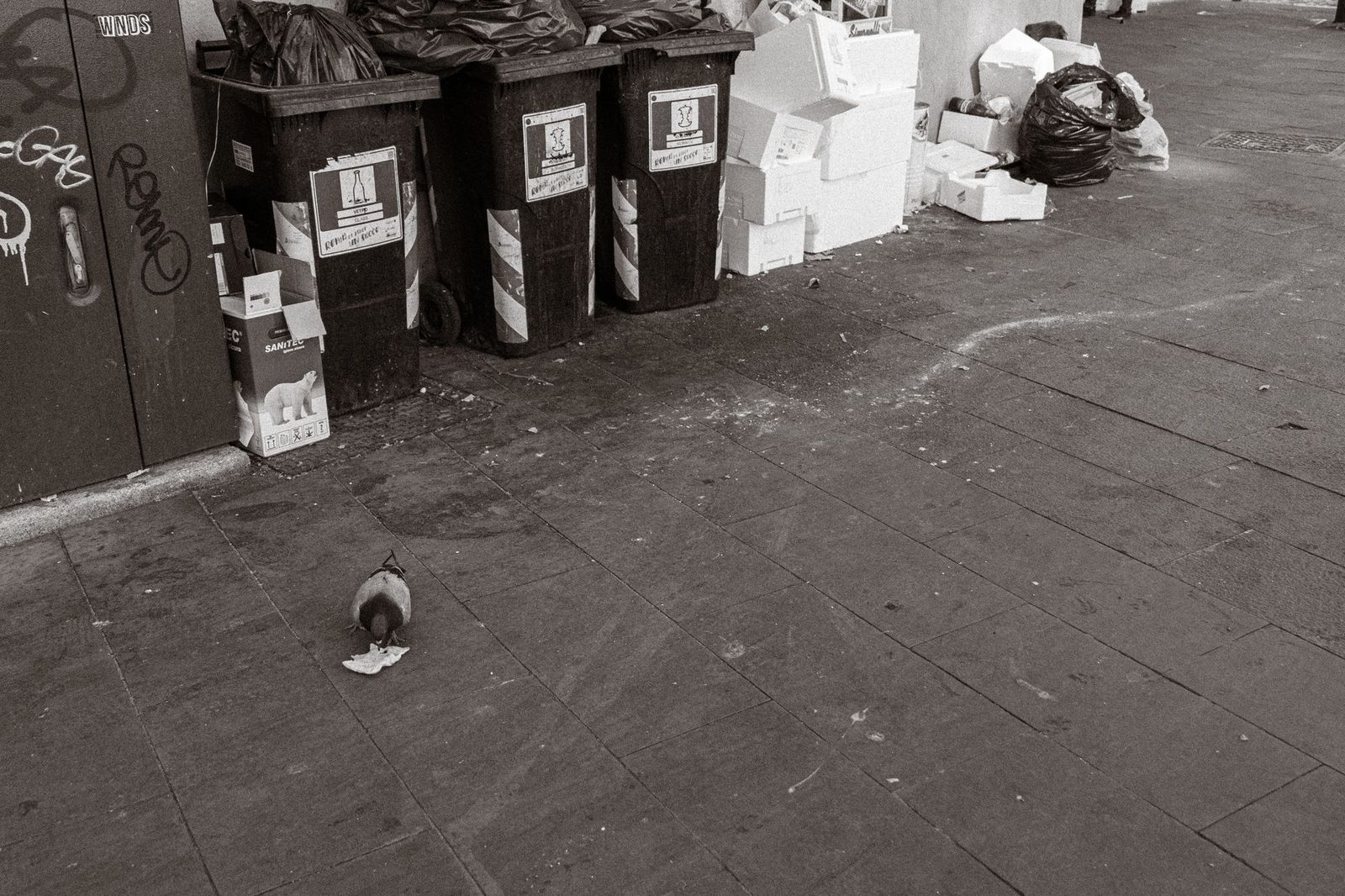
Overflowing bins, cardboard boxes and rubbish bags on an urban pavement, with a pigeon pecking at the ground

The one-afternoon protocol

A proper walk-round of the house takes two hours. Here is the order that saves the most time.

1. Do a full circuit at floor level. On your knees, with a powerful rechargeable torch held horizontally against the floor: raking light reveals the contours, the dips and the rub traces that front-on lighting wipes out completely. You're looking for three things: daylight under the door, greasy grey smears (the "rub marks" left by the animals' fur), and gnawing debris at the corners.

2. Measure, don't estimate. A 6 mm gap looks negligible to the eye. A feeler gauge, or simply a reference coin, prevents misjudgement.

3. Sort by door type, because the repair isn't the same:

SituationLasting repairWhat not to do
Hardened flexible sealReplace the seal with the right profileAdd a second seal over the top
Hollowed concrete thresholdLevelling compound or bonded rubber threshold rampFill it with foam
Wooden door gnawed at the bottomScrew-fixed metal plate + brush stripAcrylic filler on its own
Sliding door trackStainless steel mesh over the drainage holesBlock the drains
Swinging cat flapMicrochip flap or night-time lockingA plain "rigid" flap

4. Make the door bottom unattractive. Clear 30 cm of bare ground in front of every door: no thick doormat stored outside, no flowerpot pressed against the threshold, no bag of compost, no shoe crate. Rodents are thigmotactic and hug obstacles; bare, lit ground discourages them from hanging about long enough to gnaw.

5. Check the result at night. Two days later, dust a little flour or talc over a 20 cm strip inside each treated door. In the morning, the absence of footprints is as good as a diagnosis. Some owners prefer a motion-detecting security camera plugged in inside the garage: it is extremely effective for pinning down the time and the side of the crossing.

What proofing won't solve

We have to be honest about the limits of this approach, because that's usually where homeowners get discouraged.

Blocking a route in when rodents are already established inside doesn't make the rodents disappear: it shuts them in.

The order matters. If you hear noises at night, if you find fresh droppings or chewed packaging, you have to reduce the existing population first, then seal up. Do it the other way round and the trapped animal starts gnawing materials it would never otherwise have touched — electrical conduits, insulation, roof timbers — and may die inside a stud wall, with the smell that entails for three weeks.

To work out what you're really dealing with, reading the signs remains the foundation: see our guide to droppings and tracks and, if the animal has already moved in, how to locate the nest within the structure.

Three situations justify not dealing with the problem alone:

  • You have a brown rat, not a mouse. Large spindle-shaped droppings 15-20 mm long, burrows 6-8 cm across at the foot of a wall or a garage threshold, and wide tracks in mud all point to a rat. A rat coming under a garage door has usually arrived from an outside network — a drain, neighbouring waste ground, the sewer system — and proofing alone won't be enough.
  • The weak point is structural. A sunken threshold, a cracked garage slab, a crawl space open to the outside: these are building works, not a clip-in seal.
  • You've already treated it twice with no result. Identical recurrences almost always mean a second access point hasn't been identified.

On the rules governing product use, a reminder of the framework: rodenticides sold to the public are regulated biocidal products, and ANSES (the French Agency for Food, Environmental and Occupational Health & Safety) regularly points out that over-the-counter anticoagulant bait must be kept in a secured station, out of reach of children and pets. We set out that framework in detail in what a private individual can really use. For the towns in the département, municipal public health departments and the Conseil départemental du Val-de-Marne (Val-de-Marne County Council) also issue public health guidance and run rat control campaigns on the public network: reporting the problem to your town hall is always worthwhile when the source is clearly outside your own property.

The key points

  • The bottom of a door is rodents' primary way into a house, ahead of cracks and drains.
  • 6-7 mm is enough for a mouse, 20 mm for a brown rat. A sliver of light = a way in.
  • The four doors to check: garage, side door, sliding patio door, cat flap.
  • Expanding foam doesn't hold. The right seal profile, a dense brush strip, a metal plate, stainless steel mesh: those are the only lasting repairs.
  • You reduce the population before sealing up, never the other way round.

An on-site survey clears up the doubts in a single visit: locating the access points, identifying the species, and a costed proofing plan. You can look through our services and our prices, check whether your town is in our service areas and write to us for a quote. If rodents are already moving around inside the home at night, go straight to the emergency page.

#prévention#dératisation#logement#automne#conseils#Val-de-Marne#traitement

A pest problem?

Our experts act fast and for good. Request a free assessment.

Request a free quoteOur services

← Back to the blog

CallFree quote