It is small, discreet, nocturnal, and only bites when crushed against the skin. Yet the Mediterranean recluse spider (Loxosceles rufescens) has found itself at the centre of health news this summer 2026. The trigger: a severe case in Malaga in May 2026, a 37-year-old Spaniard who narrowly avoided arm amputation after a necrotic bite (Le Parisien, 8 June 2026), and the reminder by French emergency physicians, at the French Society of Emergency Medicine congress in June 2025, that "some necroses can lead to amputation" (Le Dauphiné). In France, the spider has long been present in Provence-Alpes-Côte d'Azur, Corsica and Occitanie, but the recent media coverage is reviving identification requests and fears. Here is what you really need to know to avoid confusing a common harmless spider with a bite that justifies the emergency room.
Why the recluse spider is in the news in 2026
Several factors combine to explain the media coverage of the recluse spider this summer:
- Two deaths in Italy in 2024 in the Apulia region, and around twenty hospitalisations in PACA and Corsica between 2022 and 2025, including 5 people operated on in 2024 according to the Marseille poison control centre. The risk is low, but it exists and is documented.
- A dramatic case in Malaga (May 2026) in a 37-year-old man bitten in his sleep: fever at 39 °C, cutaneous necrosis of the forearm, emergency surgery to stop the spread. The event was widely covered by the European press.
- A slow but real northward expansion of the range, favoured by warmer winters and urbanisation. Reports in Occitanie (Pyrénées-Orientales, Aude, Hérault) and in the Rhône Valley have been rising since 2022.
- Very frequent confusion with other domestic spiders (cellar spiders, house spiders, garden spiders), which generates both identification requests and, conversely, real bites that are misdiagnosed.
In France, the recluse spider is not classified as an invasive species or a regulated pest. Nor is it subject to mandatory reporting. But its bite — through its necrotic venom based on sphingomyelinase D — can, in 5 to 10 % of cases, cause a serious skin lesion that requires prompt medical care.
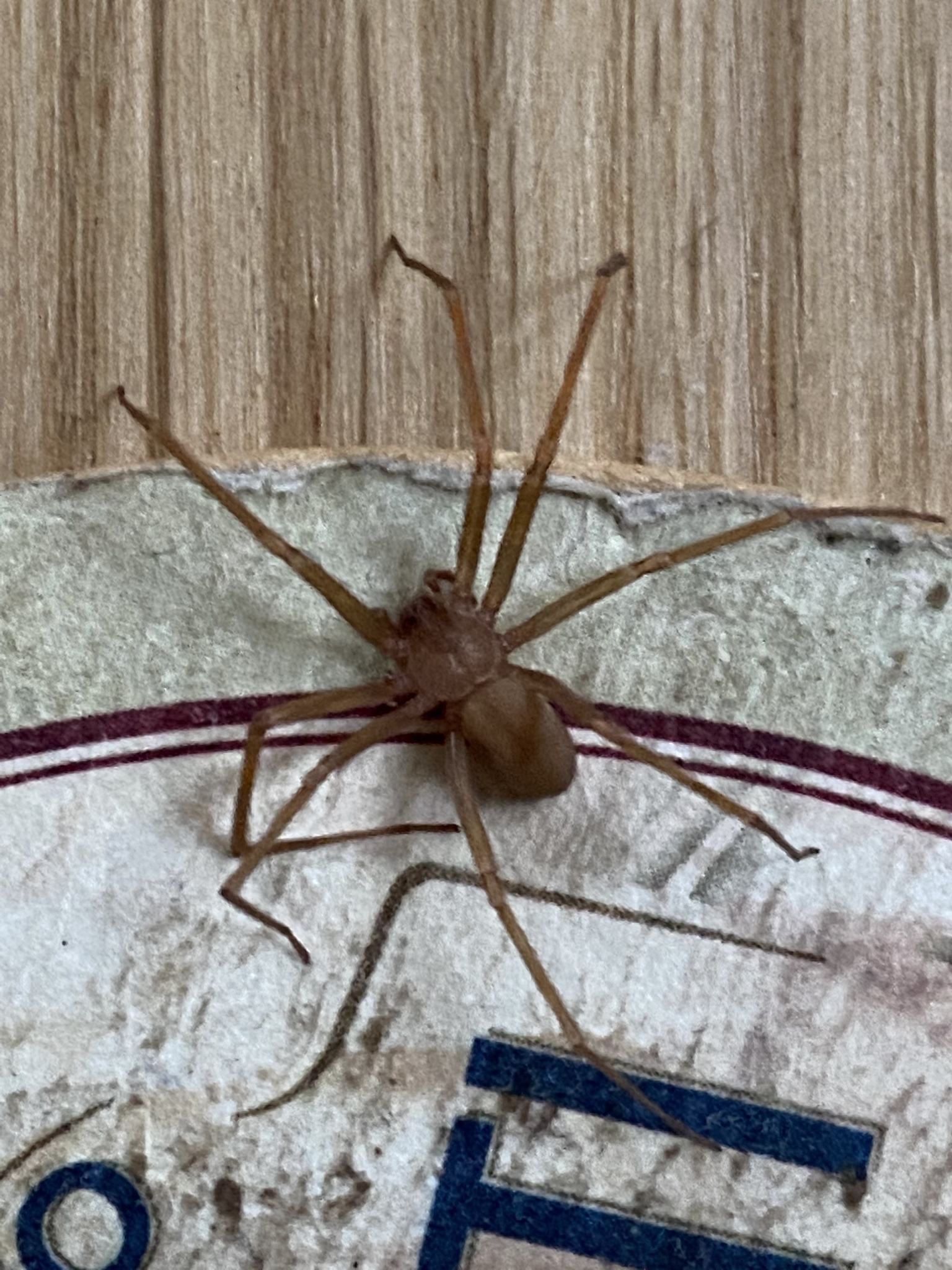
Recognising the recluse spider
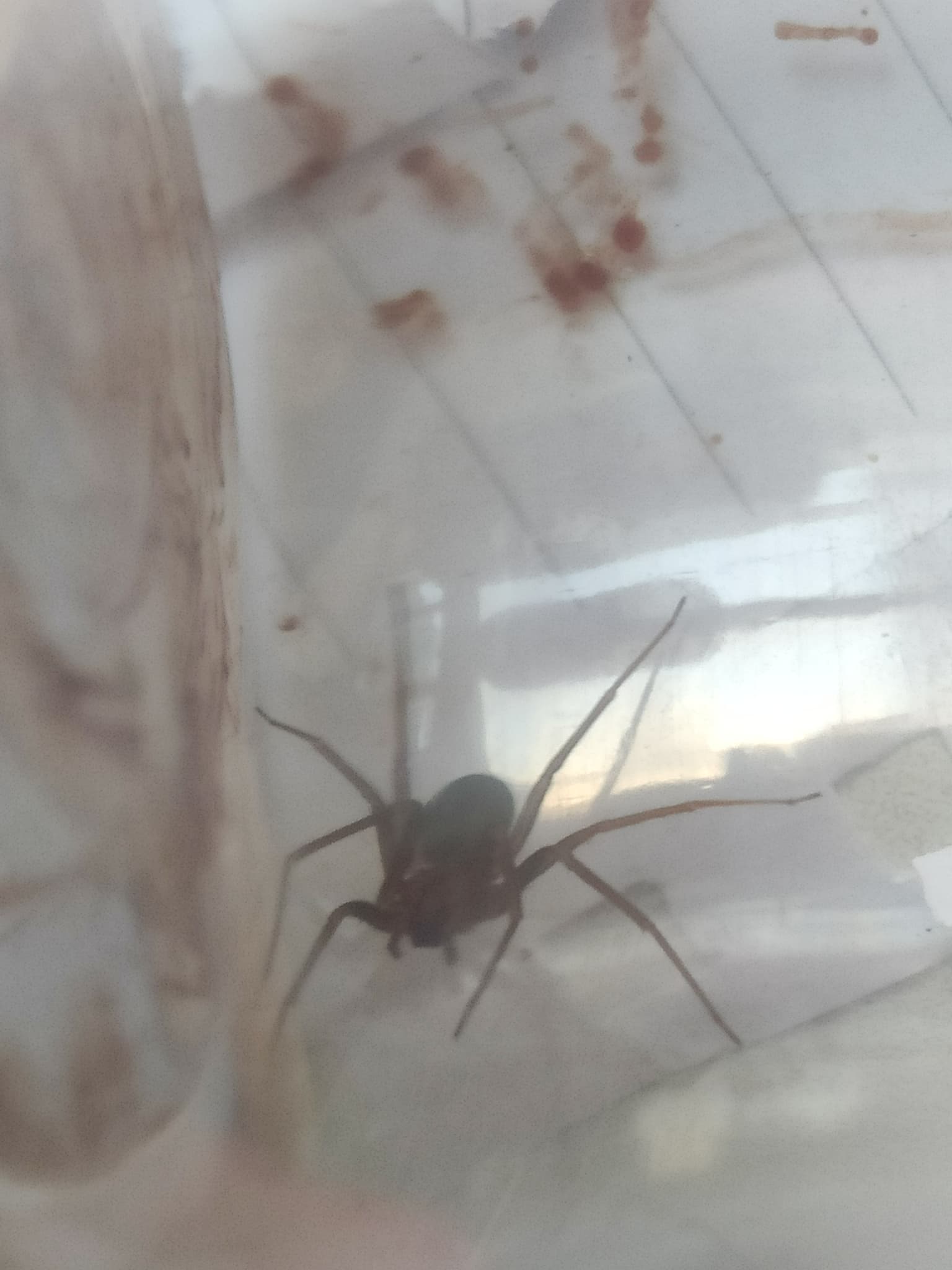
Confusion is massive with the spiders commonly found in homes. Here are the five criteria that make it possible to identify Loxosceles rufescens without ambiguity.
1. Size and colour. As an adult, the recluse spider measures 7 to 10 mm in body (legs included: 4 to 5 cm). Its colour is uniformly sandy to rusty, without contrasting bands or patterns on the legs. It is a "drab" spider, which makes it easy to confuse with an immature house spider.
2. The violin-shaped mark. This is the most well-known sign: on the cephalothorax (the front part, which bears the eyes), there is a dark mark whose shape resembles a violin or a guitar. This criterion alone is not enough, because several species bear similar patterns, but it is a good clue when combined with the others.
3. The eyes: 6, not 8. Most spiders have 8 eyes. The recluse has only 6, arranged in three pairs (one median pair and two lateral pairs). This detail requires a magnifying glass, but it is the scientific reference criterion.
4. Behaviour. Nocturnal, very discreet, it shuns the light. It spins an irregular sheet web, loosely structured, in dry, warm and dark places: cellars, attics, garages, crawl spaces, behind furniture, under skirting boards, in stored boxes, behind household appliances. It does not jump, does not climb smooth walls, and generally stays on the ground.
5. Coexistence with humans. Unlike the cellar spider or the house spider, the recluse does not live in plain sight. It is discovered by chance when moving an object, cleaning a cellar or putting on a garment left on the floor. It is precisely this accidental encounter that causes bites: the person crushes the spider against their skin without seeing it.
In case of doubt, photograph the specimen (top view + close-up of the eyes) and send the photo to a poison control centre or via the online reporting application of the INPN (National Museum of Natural History).
Bites: what really happens
A recluse spider bite is often painless at first — a simple prick that can be confused with a mosquito bite or skin irritation. It is in the 12 to 48 hours that follow that the picture can become worrying.
Typical evolution of a bite that becomes complicated:
- Hours 0 to 6: small red mark, moderate pain, sometimes itching. The victim does not seek care.
- Hours 6 to 24: the lesion expands, becomes more painful, takes on a purplish aspect at the centre. An erythema develops around it.
- Hours 24 to 72: formation of a necrotic plaque (black or greyish, dry area). In severe cases, fever, malaise, nausea, joint pain. The necrosis can reach several centimetres and require surgical excision.
- Beyond D7: slow healing (several weeks), sometimes aesthetic sequelae.
Actual statistics from the Marseille poison control centre and the medical literature:
- 70 % of bites remain benign (simple local reaction).
- 20 % lead to a moderate lesion requiring medical monitoring.
- About 10 % progress to significant necrosis, justifying surgical treatment.
- No deaths documented in France to date, unlike Italy in 2024 (2 deaths) or some South American countries where Loxosceles reclusa (the North American species, more dangerous) causes hundreds of deaths a year.
Note: the European recluse spider (L. rufescens) is considerably less virulent than its North American cousin L. reclusa, absent from European territory. The risk of severe necrosis in France is low, but not zero.