Five years after its first official detection in Marseille, the Oriental hornet (Vespa orientalis) continues to establish itself in France. Until recently confined to the Mediterranean fringe, it is now documented in several south-eastern departments and triggered an isolated report in Blois (Loir-et-Cher) in January 2026. For households, beekeepers and public-space managers, this new arrival forces a rethink of monitoring and control reflexes, because its biology does not match that of the Asian hornet.
Where does the Oriental hornet come from?
The Oriental hornet is a Mediterranean species, native to a wide range stretching from southern Europe to Central Asia. It has no business being in northern France. Its arrival in Marseille is most likely linked to maritime traffic: the first observations of 2021 were made in the La Cabucelle neighbourhood, near a wasteland of the Saint-Louis factory close to the port, and along the Aygalades stream, a north-south dispersal corridor.
The hypothesis of an introduction through imported goods (timber, ornamental stones, containers) is now favoured by MNHN and PatriNat teams, who track the species' progression through the frelonasiatique.mnhn.fr portal.
A snapshot of the 2021-2026 progression
| Year | Key observation |
|---|---|
| 2021 | First confirmed nest in Marseille (La Cabucelle) |
| 2022 | Nest destroyed in Plan-de-Cuques, suspected nests across the Marseille area |
| 2023 | Detection in the Var and Alpes-Maritimes — listed in Annex II of IAS (Invasive Alien Species) |
| 2024-2025 | Stabilised observations in PACA, growing reports in Italy and Belgium |
| January 2026 | Isolated report in Blois (Loir-et-Cher), awaiting confirmation |
The currently documented range remains PACA (Bouches-du-Rhône, Var, Alpes-Maritimes, Vaucluse). The Blois report, from a single beekeeping source, has not yet been confirmed by an institutional body, but it illustrates the species' dispersal capacity: queens can cover several kilometres when founding a colony.
How to recognise the Oriental hornet?
Confusion with the Asian hornet (Vespa velutina) and the European hornet (Vespa crabro) is common. Yet the field marks are clear:
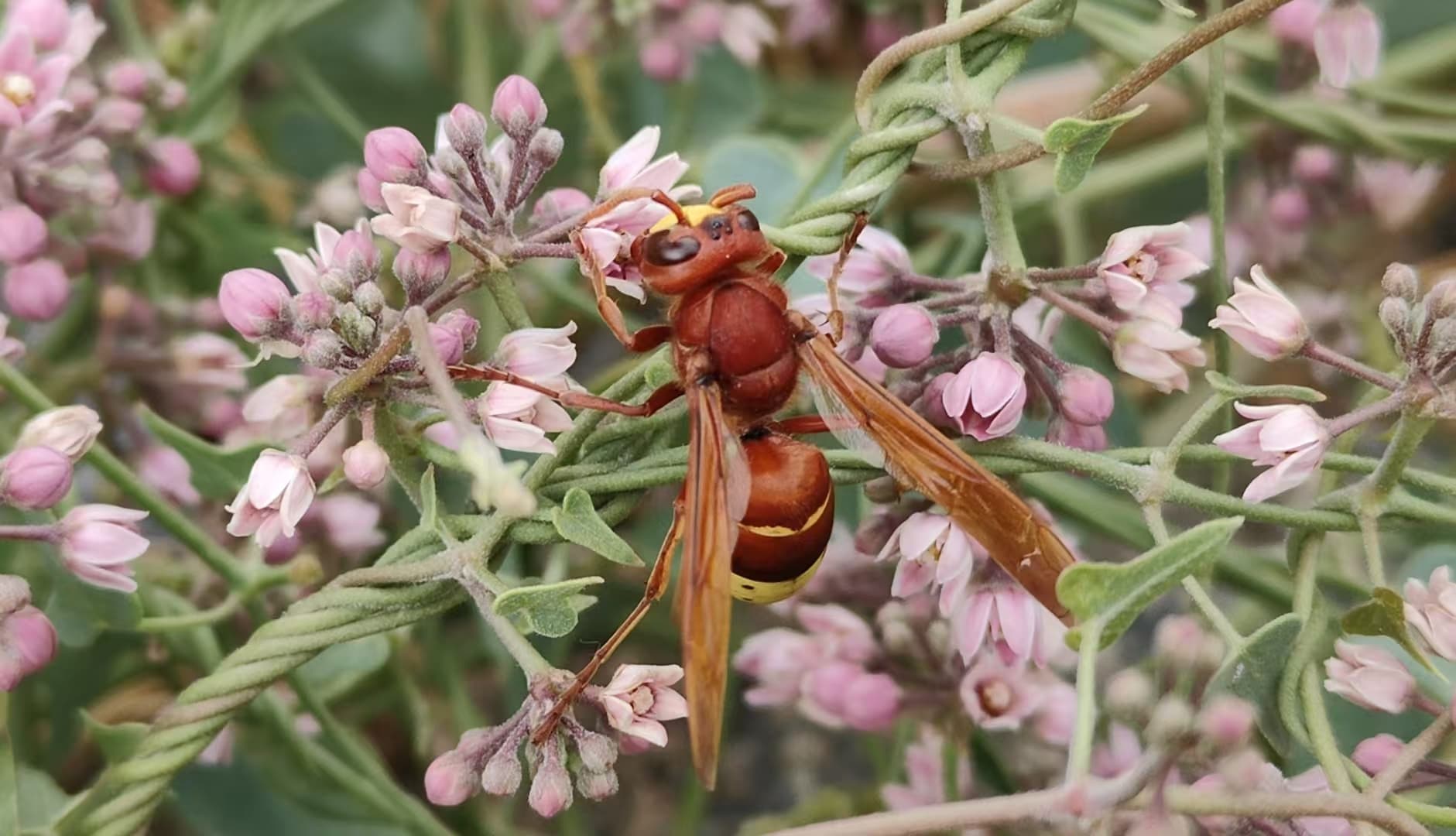
- Uniform reddish-brown abdomen with a broad yellow band — not the dark abdomen of the Asian hornet, nor the bright yellow-with-black-dots of the European hornet.
- Orange, almost red face when viewed head-on — the most reliable field criterion.
- Reddish-brown legs with little contrast.
- Size close to the Asian hornet (workers 18-23 mm, queens 25-30 mm).
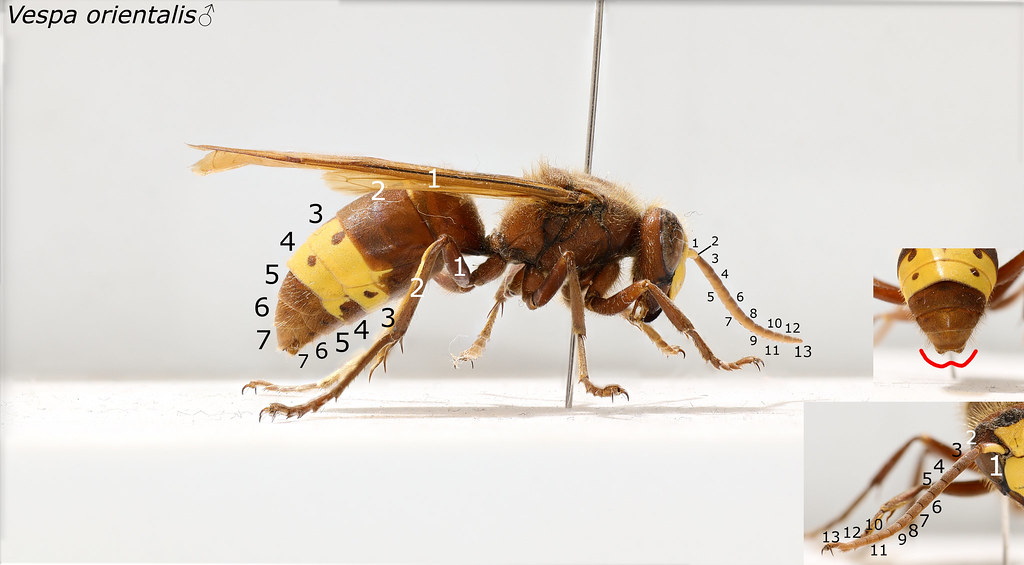
The MNHN anatomical plate below breaks down each segment.
A biology that changes everything for control
Unlike the Asian hornet, which builds spherical aerial nests, the Oriental hornet has a distinctive trait: it nests in the ground or in cavities (hollow walls, shutter-box housings, under slabs, old burrows, dry banks). No external envelope is visible. Direct consequences:
- Spring trapping with bottles or queen traps is still useful, but placement must target known nesting sites.
- Aerial nest destruction with a telescopic pole is ineffective: the cavity must be opened, the biocide injected at the heart of the brood, then sealed.
- Defensive aggressiveness is stronger than in V. velutina, with an attack radius that can extend several metres.
This nesting habit explains why the national strategy designed for the Asian hornet — often reduced to spotting nests up high — cannot be transposed. Control requires a prior diagnosis by a trained operator, capable of locating the cavity and adapting the method.